Start typing to search this publication.
Brandon Donnelly logo Brandon Donnelly
Open menu
Brandon Donnelly logo

Subscribe to Brandon Donnelly

Get new posts delivered straight to your inbox.

Brandon Donnelly — Daily insights for city builders. Published since 2013 by Toronto-based real estate developer Brandon Donnelly. — Page 8

Cover image for Toronto’s grand bargain gave us nodes instead of neighbourhoods

Toronto’s grand bargain gave us nodes instead of neighbourhoods

  • Development
  • Planning
  • Toronto

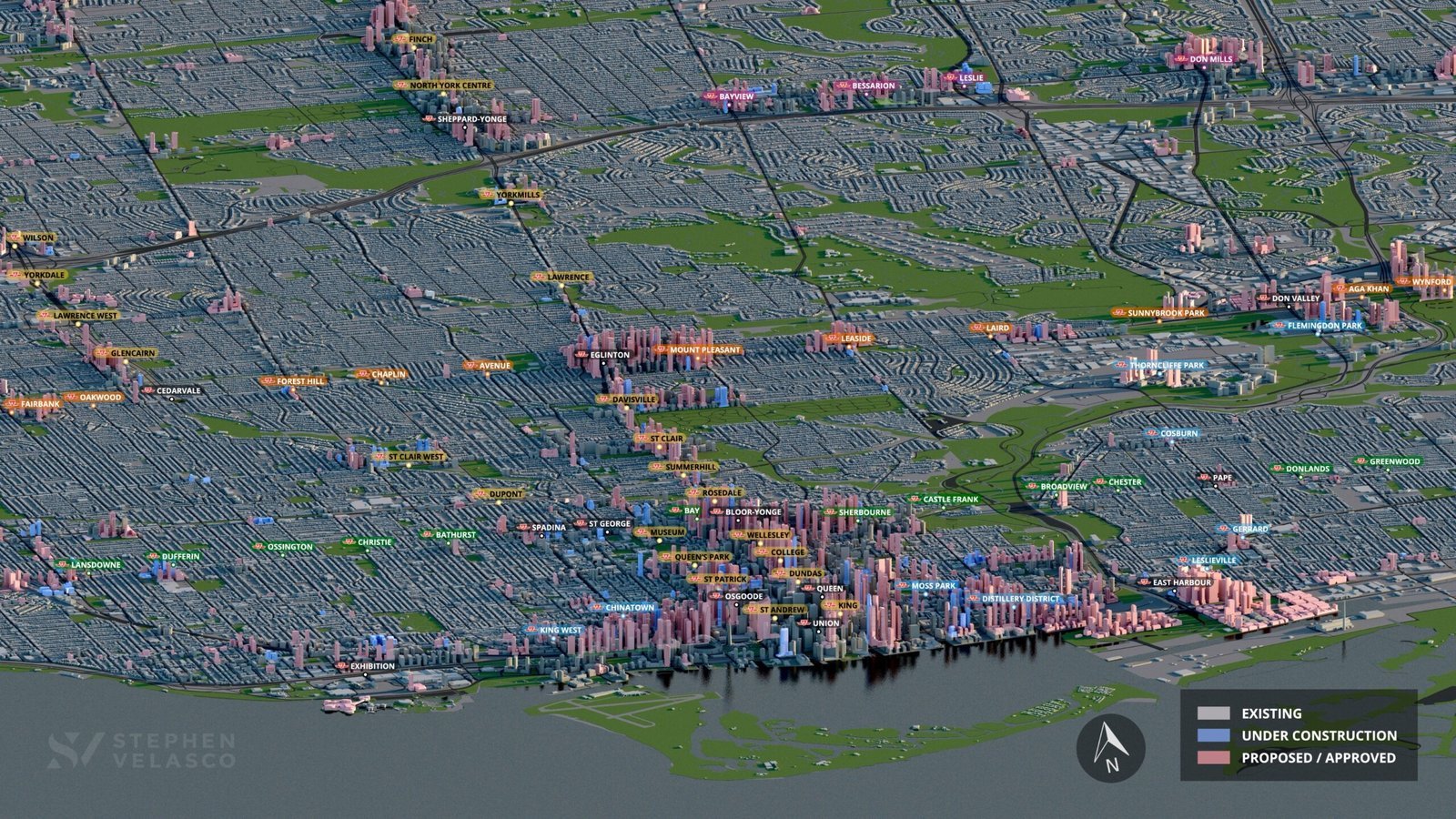
Stephen Velasco maintains a wonderful set of models for Toronto showing existing, under-construction, and proposed/approved developments. Here’s his website and here’s an aerial he recently shared showing a large section of the city overlaid with subway and LRT stations.

What is abundantly clear from this visualization is the “grand bargain” that has guided development in Toronto for over two decades: we won’t touch most of the low-rise residential land in the city, and instead we will create high-rise pockets next to transit.

This was the path of least political resistance, and while building on top of and next to transit is obviously sound, the extreme density cliff we encouraged created several urban economic and city-building distortions.

Land became artificially scarce, even though there’s lots of room within the boundaries of Toronto. And high density became our only option, eliminating many other housing typologies for Torontonians. But perhaps most importantly, it created an urban fabric of dense nodes that in many cases aren’t actually urban.

What this means is that most of the city remains unwalkable, without urban amenities, and clogged with car traffic. The way to better use our existing transit infrastructure, create more amenity-rich communities, and reduce Toronto’s dependency on the car is to flank these isolated tower clusters with more evenly distributed density.

Towers on top of stations are, of course, good, but there then needs to be a gradient of 4-12 storey buildings across the surrounding avenues, major streets, and interior residential streets.

The good news is that we’re moving in this direction. It’s just going to take time for us to firmly strike a new grand bargain. But in my view, this city-building approach is going to guide the next two decades of development in Toronto.


Aerial visualization by Stephen Velasco
What Ben’s $270-a-month SoHo loft tells us about cities

  • Architecture
  • Art
  • Urbanism

I clicked on this artist’s loft tour by Joshua Charow for two reasons: (1) it’s the kind of big, creative loft space that I would love to have for fun, and (2) $270 per month for a SoHo loft seems kind of reasonable.

The artist is Ben Schonzeit. He moved into the space in 1972, and this was his all-inclusive gross rent. In today’s dollars, Gemini estimates this to be around $2,175 per month, which no longer sounds so dirt cheap, but remains very reasonable for a massive high-ceilinged loft in SoHo. (As an aside, I don’t think most people calculate in real dollars all that well.)

There’s a lot that comes to mind with Ben’s story:

  • The creation of architectural cast iron changed the economics around ornate facades like the ones you see in SoHo. But at the time, these would have been seen as cheap replicas of the original stone stuff. Architectural purists would have derided these facades for not following the doctrine of “truth to materials.” Of course, today, many would now view SoHo as an example of “we don’t build things like we used to.”

  • Cities operate in cycles. But the flexible nature of these buildings, with their wide-open spans and large windows, allowed them to be easily repurposed.

  • Ben and his artist contemporaries were gentrifiers of the neighbourhood. And they would have long been displaced by the market had they not been protected by policy. One way to look at this dynamic is that they’re getting paid — through below-market rents — for the cultural cachet they created and the sweat equity they put into gentrifying the area.

One of Jane Jacobs’s famous city-building mantras was, “Old ideas can sometimes use new buildings. New ideas must use old buildings.”” The reasoning for this is that new construction is expensive, whereas old, out-of-favour buildings offer the low-cost leeway needed for new ideas.

This was certainly true when Ben was signing his lease in SoHo following deindustrialization. But is it still true today? The new idea du jour is AI, and that seems to require a lot of new buildings. Fifty years from now, will there be new SoHo stories similar to Ben’s?

Cover image for Not every neighbourhood wants to be urban

Not every neighbourhood wants to be urban

  • Planning
  • Urbanism
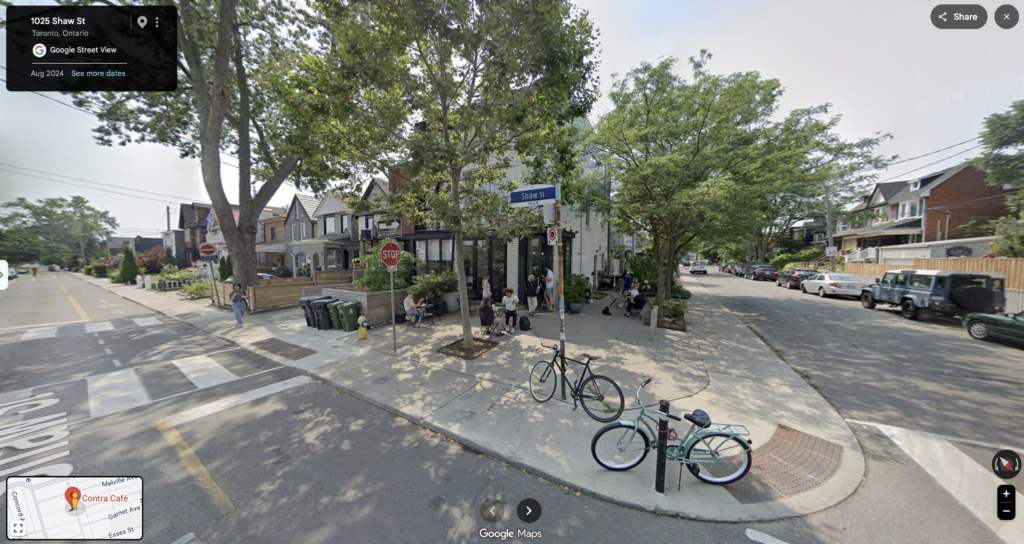
  • Contra cafe

Many cities today treat local retail the way medieval towns treated tanneries: as an offensive nuisance that must be segregated from where people live. This has led us to our current debate over whether small-scale retail should be allowed deep inside residential neighbourhoods. It’s allowed, sometimes.

The detractors like to get people excited by suggesting that this will lead to all-night raves, multinational chains, or streets being overrun with cars. But of course, that is not what we’re talking about.

There are lots of case studies that we can point to. Japan, for instance, has a national zoning code that permits small-scale shops, home offices, and cafes in even its lowest-density, residential-only zone. From there, all subsequent zones work cumulatively, meaning more intensive zones generally inherit all previous uses. The result is a land-use approach that is default mixed-use.

Of course, there are also lots of examples that we can point to here in Toronto, and that’s because corner stores used to be a part of our daily life. But these remnant examples are generally found in the oldest, and most urban, parts of the city, and rejected in the inner suburbs.

It is no surprise that Toronto is once again divided on this issue and across its typical built-form lines. This division runs deep, and it will almost certainly resurface when Torontonians head to the polls this Monday.

At the end of the day, corner stores and local retail are an inherently urban sensibility. It is about not having to get into a car to grab a coffee or a soft washed-rind French cheese from Haute-Savoie. But we know that not all communities want to be urban.

One resident’s feature is another’s bug.

Subscribe to Brandon Donnelly

Daily insights for city builders. Published since 2013 by Toronto-based real estate developer Brandon Donnelly.