Start typing to search this publication.
Brandon Donnelly logo Brandon Donnelly
Open menu
Brandon Donnelly logo

Subscribe to Brandon Donnelly

Get new posts delivered straight to your inbox.

Brandon Donnelly — Daily insights for city builders. Published since 2013 by Toronto-based real estate developer Brandon Donnelly. — Page 10

Cover image for Why new homes will not kill the vibe in Bloor West Village

Why new homes will not kill the vibe in Bloor West Village

  • Development
  • Housing
  • Urbanism

I learned about this development proposal over the weekend through a Toronto Star article that I couldn’t read because it was behind a paywall. Oh well, here’s the Twitter post and the headline: “Once built, the 60-unit tower will be the only one on the strip. Locals say it will kill the area’s vibe.”

The original proposal was a 16-storey mixed-use building at 2273-2279 Bloor Street West in Bloor West Village, but through negotiations with the City, it was reduced to 14 residential floors plus a mechanical penthouse wrapped with indoor and outdoor amenity spaces. The height is just under 50 metres, and the resulting FSI for the site is 9.2. What you see above is the revised massing (via UrbanToronto).

So, will it kill the area’s vibe?

One way to look at the proposal is that it’ll be the “only one.” But the other way to look at it is that we’ve historically underbuilt along one of our major subway lines and that it’s a positive indicator that we’re now seeing proposals like this being brought forward. This is good. It’s a fine-grained urban proposal with 50% two- and three-bedroom suites and zero parking.

The question we should be asking ourselves is: how do we encourage more of this? The future of Toronto lies not in the two- to three-storey buildings you see depicted above, but in a mix of denser buildings that will unlock additional homes in the city and allow Toronto to wean itself off its dependency on the car. People are what create the vibe.
Cover image for The geometric impossibility of the car-centric metropolis

The geometric impossibility of the car-centric metropolis

  • Mobility
  • Toronto
  • Urbanism

The Katy Freeway in Houston has 26 lanes at its widest, and after a $2.8 billion expansion between 2003 and 2008, commute times reportedly increased by 30-50%.

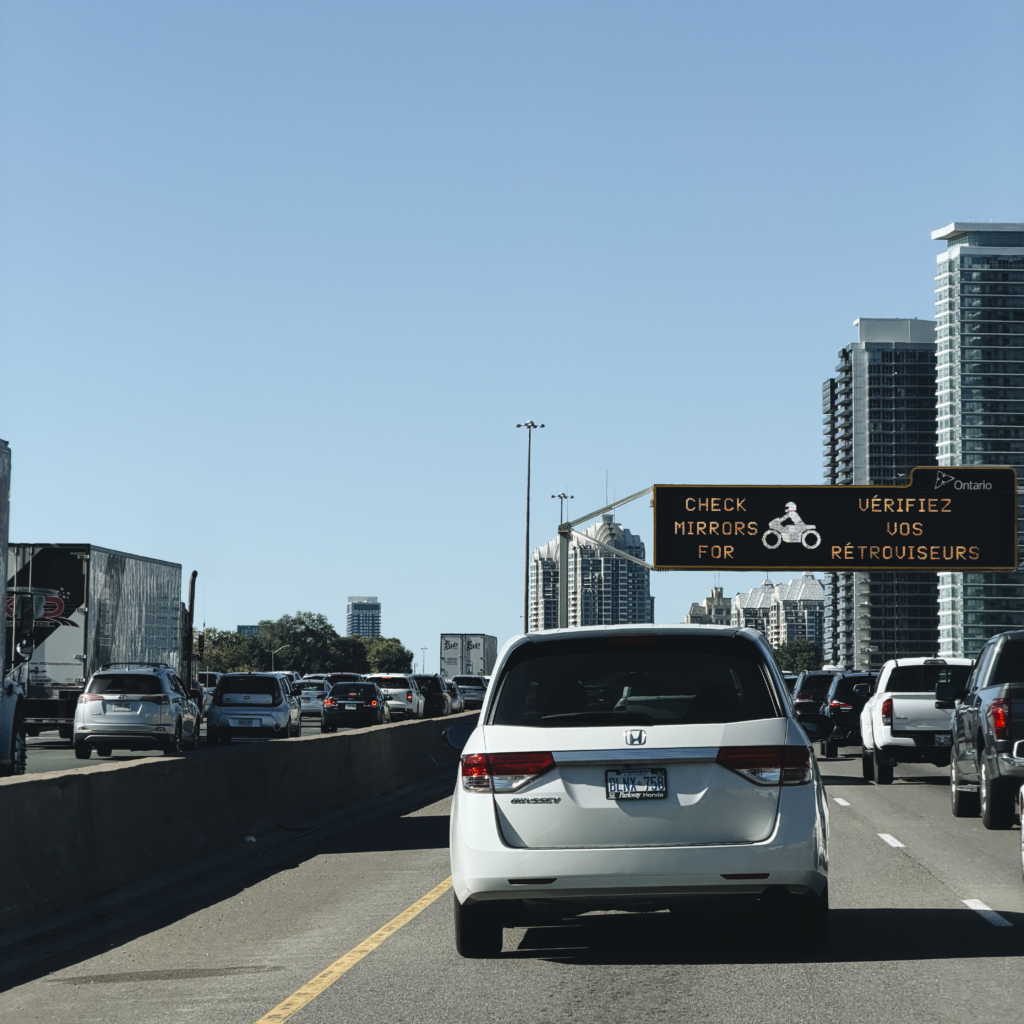
Highway 401 in Toronto has 22 lanes at its widest and is ranked as the busiest highway in North America with an average of ~500,000 vehicles per day. It does not flow freely at most times throughout the day.

Avenida 9 de Julio in Buenos Aires is one of the widest surface avenues in the world, but traffic congestion didn’t improve until lanes were converted into a bus rapid transit line.

Sheikh Zayed Road in Dubai ranges from 12-16 lanes and acts as the main high-capacity spine for what is a linear, car-dependent global city. It too is known for its traffic congestion.

The common thread among all of these examples is that, irrespective of the width and number of lanes, none of these cities have solved the problem of traffic congestion. I challenge you to think of a counterexample. And that is because it is impossible to build a large, economically vibrant global city centered primarily around private automobiles without suffering severe traffic congestion.

The car is the most spatially inefficient mode of transport for cities, and this doesn’t change with tunnels or with autonomous vehicles (at least sufficiently to make this statement wrong). The fundamental issue is one of space: too many cars for a finite amount of road capacity.

People who live in car-dependent communities are reluctant to accept this reality, but the only proven solution to congestion is to reorient away from the car toward more efficient modes of transport, namely mass transit. And one of the most effective ways to make this switch is to price roads and congestion.

This is not to say that individual cars don’t have a place in global cities; they of course do. It is to say that it’s impossible to rely on them as the primary means of mobility without there being negative consequences.

It’s also worth pointing out that one of the core features of cities is agglomeration economies, which is to say that the spatial concentration of activities leads to cost savings, productivity gains, and greater innovation. Cars demand the exact opposite: spatial dispersion.

Which would you rather optimize for?

Cover image for The world is going electric

The world is going electric

  • Environment
  • Mobility
  • Colin mccarthy

Here’s a telling chart from Colin McCarthy: The world is going electric, except for the US. The chart shows the rolling 12-month share of new battery-electric vehicle sales (plug-in hybrids excluded). The callout for the US marks the end of the federal EV tax credit in September 2025. The adoption curve reflects demand being pulled forward prior to its expiry, followed by the expected falloff. Among the long list of other things going on in the US, it is highly disappointing to see the politicization of renewable energy.

Subscribe to Brandon Donnelly

Daily insights for city builders. Published since 2013 by Toronto-based real estate developer Brandon Donnelly.