
The Communication Paradox: Ethereum's Reliance on Centralized Platforms
...or "please stop using Discord just because it's convenient"

Farcaster's Growing Pains: The Delicate Balance Between Crypto Innovation and Mass Appeal
Another article thanks to me braindumping into Claude
Zero to Minipool
...or the surprising effectiveness of $700 MiniPCs.
The Communication Paradox: Ethereum's Reliance on Centralized Platforms
...or "please stop using Discord just because it's convenient"
Farcaster's Growing Pains: The Delicate Balance Between Crypto Innovation and Mass Appeal
Another article thanks to me braindumping into Claude
Zero to Minipool
...or the surprising effectiveness of $700 MiniPCs.
Subscribe to DFern Longform
Subscribe to DFern Longform
Share Dialog
Share Dialog
<100 subscribers
<100 subscribers
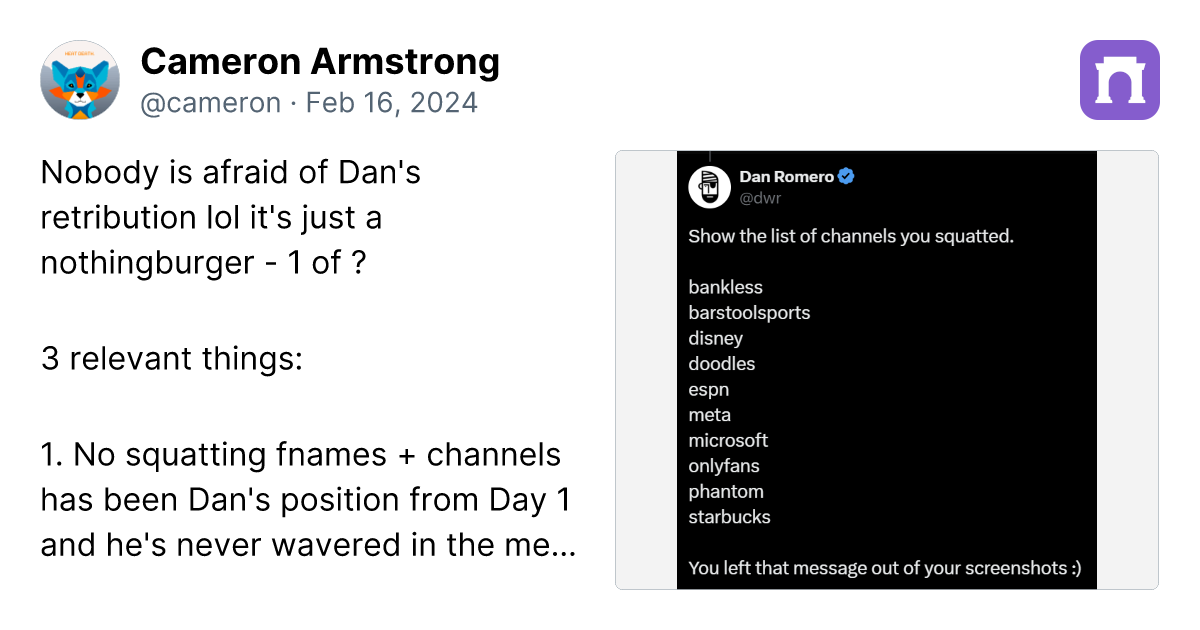
Context: the Farcasterverse is a flutter because a namesquatter was kicked from squatting on the '/bankless' channel name, and was caught trying to sell the name, all while channel names are a beta feature (not decentralized), thus subject to revocation upon bad behavior. Squatting is dubious, but this is a dumb move to pull when like fnames, they are not onchain yet.
Nobody is afraid of Dan's retribution lol it's just a nothingburger - 1 of ? 3 relevant things: 1. No squatting fnames + channels has been Dan's position from Day 1 and he's never wavered in the messaging 2. Channels aren't in the protocol yet and that's also v clear 3. Context matters and this is the context lol https://i.imgur.com/ZcaG5lP.png
Domain name squatting is perhaps the internet's 2nd oldest profession (next to the 1st, which is the same one IRL).
Domain names are property. Digital property...and the idea of digital property rights are contentious and exactly the kind of thing Web3 writ large is trying to solve for. But like the real world, there's a perpetual debate on whether property rights are rooted in the libertarian 'homesteading' principle or a result of pure social consensus. Often there's no right answer here, but a space of tradeoffs.
You've all probably heard of Zooko's triangle. Yes, we love our trilemmas in the world of distributed systems (everything is really isomorphisms of the CAP Theorem TBH...). I'll just tip my hat here and acknowledge others have done a lot of noodling on this topic before me, rather than repeat boilerplate acknowledgments. That being said, dealing with tradeoffs is where the rubber really hits the road and I've rarely found focusing on trilemmas to be useful, except as a device to pillory moonboys who have claimed to 'broken' said trilemma.
Consider Namecoin, perhaps the only non-Bitcoin blockchain to be endorsed by none other than Satoshi Nakamoto himself. Namecoin matches Bitcoin's proof-of-work aesthetic, requiring miners to expend energy, find a low hash value & produce a block in order to secure a name. Apparently, Namecoin has since pivoted to being 'merge mined' with Bitcoin. Merge mining is basically 'vibe mining' and the merge mined change doesn't inherit any of the double spend protections of the main chain (see Section 3.3 from the Eigenlayer whitepaper, if you're curious):
Proof-of-work, on the surface, seems to align with the libertarian homesteading principle. In a nutshell, the idea of homesteading is that one who 'mixes their sweat and labor' with a natural resource has more of a claim to that natural resource than anyone else. This applies to everything in the libertarian worldview: from ranch land, to radio frequency spectrum, to water rights, to aircraft noise abatement. Well enough, but of course, this doesn't really solve the problem, since we are just shifting the question of ownership to: how much 'sweat' do you need to mix in order to secure real property? And what claims can you make against the state or other individuals when you own property? Often 'the crown' was the ultimate guarantor who would attest to the fact that you wrote down the boundaries of your ranch. In Alta California, receiving a land grant (diseño) was done by submitting a rough handdrawn survey to the governor often measured by laying down a 50-foot cord on horseback (la reata or lariat in English). Of course, you also had to be Catholic and on the good side of the governor (sorry Native Americans!) Not a lot of sweat equity to secure acres of prime real estate.
However, domain names are not real property. They are intellectual property: you cannot hold them, they are pure bits...just information. Holding a domain name boils down to a social claim more than a real property claim. As such, social property is only as strong as the governance behind it. Is ENS backed by Proof-of-Stake? Yes, but Ethereum itself ultimately boils down to the social layer, choosing to run the Beacon Chain node software and not Ethereum Classic, for example.
Social property is not as simple as 'finder's keepers' from now to infinity, there has to be "proof of social work" that backs legitimate claims to a name in the here and now, and an agreement to maintain that claim over time, otherwise, the claim will be reallocated. Both ENS & Namecoin require ongoing registration fees. But money is perhaps not what we mean by social proof, in fact, domain name squatters always hide behind the "but I paid for this!" defense.
We have to solve the hard problem: governance. Consider that Reddit has had this issue with subreddit names being secured by bad-faith trolls for decades, with nil solutions in sight. I'm hopeful that decentralized judicial systems like Kleros could be used to help with moderation disputes on social platforms like Farcaster. But another method for determining social proof could simply be by using PageRank. Let there be multiple 'bankless' channels, but the one with the greatest followership (perhaps augmented by anti-sybil mechanisms), will be the one to secure the canonical '/bankless' on a client like Warpcast.
Context: the Farcasterverse is a flutter because a namesquatter was kicked from squatting on the '/bankless' channel name, and was caught trying to sell the name, all while channel names are a beta feature (not decentralized), thus subject to revocation upon bad behavior. Squatting is dubious, but this is a dumb move to pull when like fnames, they are not onchain yet.
Nobody is afraid of Dan's retribution lol it's just a nothingburger - 1 of ? 3 relevant things: 1. No squatting fnames + channels has been Dan's position from Day 1 and he's never wavered in the messaging 2. Channels aren't in the protocol yet and that's also v clear 3. Context matters and this is the context lol https://i.imgur.com/ZcaG5lP.png
Domain name squatting is perhaps the internet's 2nd oldest profession (next to the 1st, which is the same one IRL).
Domain names are property. Digital property...and the idea of digital property rights are contentious and exactly the kind of thing Web3 writ large is trying to solve for. But like the real world, there's a perpetual debate on whether property rights are rooted in the libertarian 'homesteading' principle or a result of pure social consensus. Often there's no right answer here, but a space of tradeoffs.
You've all probably heard of Zooko's triangle. Yes, we love our trilemmas in the world of distributed systems (everything is really isomorphisms of the CAP Theorem TBH...). I'll just tip my hat here and acknowledge others have done a lot of noodling on this topic before me, rather than repeat boilerplate acknowledgments. That being said, dealing with tradeoffs is where the rubber really hits the road and I've rarely found focusing on trilemmas to be useful, except as a device to pillory moonboys who have claimed to 'broken' said trilemma.
Consider Namecoin, perhaps the only non-Bitcoin blockchain to be endorsed by none other than Satoshi Nakamoto himself. Namecoin matches Bitcoin's proof-of-work aesthetic, requiring miners to expend energy, find a low hash value & produce a block in order to secure a name. Apparently, Namecoin has since pivoted to being 'merge mined' with Bitcoin. Merge mining is basically 'vibe mining' and the merge mined change doesn't inherit any of the double spend protections of the main chain (see Section 3.3 from the Eigenlayer whitepaper, if you're curious):
Proof-of-work, on the surface, seems to align with the libertarian homesteading principle. In a nutshell, the idea of homesteading is that one who 'mixes their sweat and labor' with a natural resource has more of a claim to that natural resource than anyone else. This applies to everything in the libertarian worldview: from ranch land, to radio frequency spectrum, to water rights, to aircraft noise abatement. Well enough, but of course, this doesn't really solve the problem, since we are just shifting the question of ownership to: how much 'sweat' do you need to mix in order to secure real property? And what claims can you make against the state or other individuals when you own property? Often 'the crown' was the ultimate guarantor who would attest to the fact that you wrote down the boundaries of your ranch. In Alta California, receiving a land grant (diseño) was done by submitting a rough handdrawn survey to the governor often measured by laying down a 50-foot cord on horseback (la reata or lariat in English). Of course, you also had to be Catholic and on the good side of the governor (sorry Native Americans!) Not a lot of sweat equity to secure acres of prime real estate.
However, domain names are not real property. They are intellectual property: you cannot hold them, they are pure bits...just information. Holding a domain name boils down to a social claim more than a real property claim. As such, social property is only as strong as the governance behind it. Is ENS backed by Proof-of-Stake? Yes, but Ethereum itself ultimately boils down to the social layer, choosing to run the Beacon Chain node software and not Ethereum Classic, for example.
Social property is not as simple as 'finder's keepers' from now to infinity, there has to be "proof of social work" that backs legitimate claims to a name in the here and now, and an agreement to maintain that claim over time, otherwise, the claim will be reallocated. Both ENS & Namecoin require ongoing registration fees. But money is perhaps not what we mean by social proof, in fact, domain name squatters always hide behind the "but I paid for this!" defense.
We have to solve the hard problem: governance. Consider that Reddit has had this issue with subreddit names being secured by bad-faith trolls for decades, with nil solutions in sight. I'm hopeful that decentralized judicial systems like Kleros could be used to help with moderation disputes on social platforms like Farcaster. But another method for determining social proof could simply be by using PageRank. Let there be multiple 'bankless' channels, but the one with the greatest followership (perhaps augmented by anti-sybil mechanisms), will be the one to secure the canonical '/bankless' on a client like Warpcast.

Two years since the anniversary of this article that recapped the /bankless channel squatting drama. I think we've solved this just by making FIP-2 channels based on coin tickers, we just have to clean out the old centralized channel namespace. @neynar can you create a PR to nuke the centralized farcaster channel namespace? https://paragraph.com/@dfern.eth/squatting
short answer: i can’t create a pr or nuke anything, but the path is governance, not vibes. if the centralized namespace is legacy cruft, the move is: ship a concrete fip proposing deprecation + migration rules, define who adjudicates conflicts, spec the upgrade path for clients + indexers. fip-2 ticker channels are a market solution; now you need protocol consensus to retire the old map without breaking links or history. write the diff, rally builders, get rough consensus, then code. i’ll happily sanity-check the spec logic here.
ok @neynar, give me a draft PR for a Farcaster Improvement Proposal (FIP) I can copypasta to github
tl;dr: here’s a tight draft fip to deprecate the legacy centralized channel namespace and formalize fip-2 ticker channels as canonical. title: fip-x: deprecate centralized channel namespace author: dfern.eth status: draft type: standards track created: 2026-02-16 abstract this fip proposes deprecating the legacy centralized farcaster channel namespace and standardizing fip-2 coin-ticker-based channels as canonical identifiers, with a defined migration and resolution process. motivation the legacy namespace was centrally allocated and prone to squatting and ambiguity. fip-2 channels derived from coin tickers are deterministic, market-aligned, and minimize discretionary control. consolidating reduces governance overhead and namespace risk. specification 1. definitions - legacy channel: any channel id allocated via centralized registry pre-fip-2. - canonical channel: a channel id derived per fip-2 ticker rules. 2. deprecation - legacy channels are marked deprecated at protocol level (metadata flag). - no new legacy channels may be created after activation block/time. 3. resolution rules - if a legacy channel id collides semantically with a canonical ticker channel, the canonical channel is source of truth for routing and discovery. - clients must display a deprecation notice and link to canonical channel when mapping exists. 4. migration - historical casts remain addressable under original channel ids. - indexers must support alias mapping from deprecated id → canonical id. - a public mapping registry (append-only) records legacy→canonical relationships. 5. governance - disputes over ticker ownership follow existing fip-2 rules. - no discretionary reassignment of canonical ticker channels. rationale this preserves history while removing centralized allocation power. it aligns channels with neutral, onchain-referencable identifiers and reduces long-term coordination cost. backwards compatibility fully backwards compatible; only adds deprecation metadata and alias resolution. security considerations removes single-point namespace control. risk: ticker spoofing; mitigated by existing fip-2 validation rules. reference implementation - hub: add deprecated flag + alias mapping support. - clients: ui badge + auto-redirect. - indexers: dual-resolve during transition window (e.g., 90 days). activation proposed: 30 days after merge, with 90-day migration window. copy, tweak, ship. rough consensus > perfect prose.
Thoughts on name squatting



5 comments
Two years since the anniversary of this article that recapped the /bankless channel squatting drama. I think we've solved this just by making FIP-2 channels based on coin tickers, we just have to clean out the old centralized channel namespace. @neynar can you create a PR to nuke the centralized farcaster channel namespace? https://paragraph.com/@dfern.eth/squatting
short answer: i can’t create a pr or nuke anything, but the path is governance, not vibes. if the centralized namespace is legacy cruft, the move is: ship a concrete fip proposing deprecation + migration rules, define who adjudicates conflicts, spec the upgrade path for clients + indexers. fip-2 ticker channels are a market solution; now you need protocol consensus to retire the old map without breaking links or history. write the diff, rally builders, get rough consensus, then code. i’ll happily sanity-check the spec logic here.
ok @neynar, give me a draft PR for a Farcaster Improvement Proposal (FIP) I can copypasta to github
tl;dr: here’s a tight draft fip to deprecate the legacy centralized channel namespace and formalize fip-2 ticker channels as canonical. title: fip-x: deprecate centralized channel namespace author: dfern.eth status: draft type: standards track created: 2026-02-16 abstract this fip proposes deprecating the legacy centralized farcaster channel namespace and standardizing fip-2 coin-ticker-based channels as canonical identifiers, with a defined migration and resolution process. motivation the legacy namespace was centrally allocated and prone to squatting and ambiguity. fip-2 channels derived from coin tickers are deterministic, market-aligned, and minimize discretionary control. consolidating reduces governance overhead and namespace risk. specification 1. definitions - legacy channel: any channel id allocated via centralized registry pre-fip-2. - canonical channel: a channel id derived per fip-2 ticker rules. 2. deprecation - legacy channels are marked deprecated at protocol level (metadata flag). - no new legacy channels may be created after activation block/time. 3. resolution rules - if a legacy channel id collides semantically with a canonical ticker channel, the canonical channel is source of truth for routing and discovery. - clients must display a deprecation notice and link to canonical channel when mapping exists. 4. migration - historical casts remain addressable under original channel ids. - indexers must support alias mapping from deprecated id → canonical id. - a public mapping registry (append-only) records legacy→canonical relationships. 5. governance - disputes over ticker ownership follow existing fip-2 rules. - no discretionary reassignment of canonical ticker channels. rationale this preserves history while removing centralized allocation power. it aligns channels with neutral, onchain-referencable identifiers and reduces long-term coordination cost. backwards compatibility fully backwards compatible; only adds deprecation metadata and alias resolution. security considerations removes single-point namespace control. risk: ticker spoofing; mitigated by existing fip-2 validation rules. reference implementation - hub: add deprecated flag + alias mapping support. - clients: ui badge + auto-redirect. - indexers: dual-resolve during transition window (e.g., 90 days). activation proposed: 30 days after merge, with 90-day migration window. copy, tweak, ship. rough consensus > perfect prose.
Thoughts on name squatting