Start typing to search this publication.
Brandon Donnelly logo Brandon Donnelly
Open menu
Brandon Donnelly logo

Subscribe to Brandon Donnelly

Get new posts delivered straight to your inbox.

Brandon Donnelly — Daily insights for city builders. Published since 2013 by Toronto-based real estate developer Brandon Donnelly. — Page 14

Cover image for A stack of single-family houses on Avenue Road

A stack of single-family houses on Avenue Road

  • Development
  • Toronto
  • Avenue road

I just stumbled across this proposal for 996-995 Avenue Road. I love it.

It is however absolutely ridiculous that the City requires side yard setbacks on Major Streets. @CityPlanTO pic.twitter.com/5yaBZ3TIVU

— Chris Spoke (@ChrisSpoke) October 6, 2026

I stumbled upon this proposal for 996-998 Avenue Road after Chris Spoke stumbled upon it. It immediately stood out to me because it’s a site we looked at when it was for sale, and because it’s a handsome-looking proposal designed by Richard Wengle.

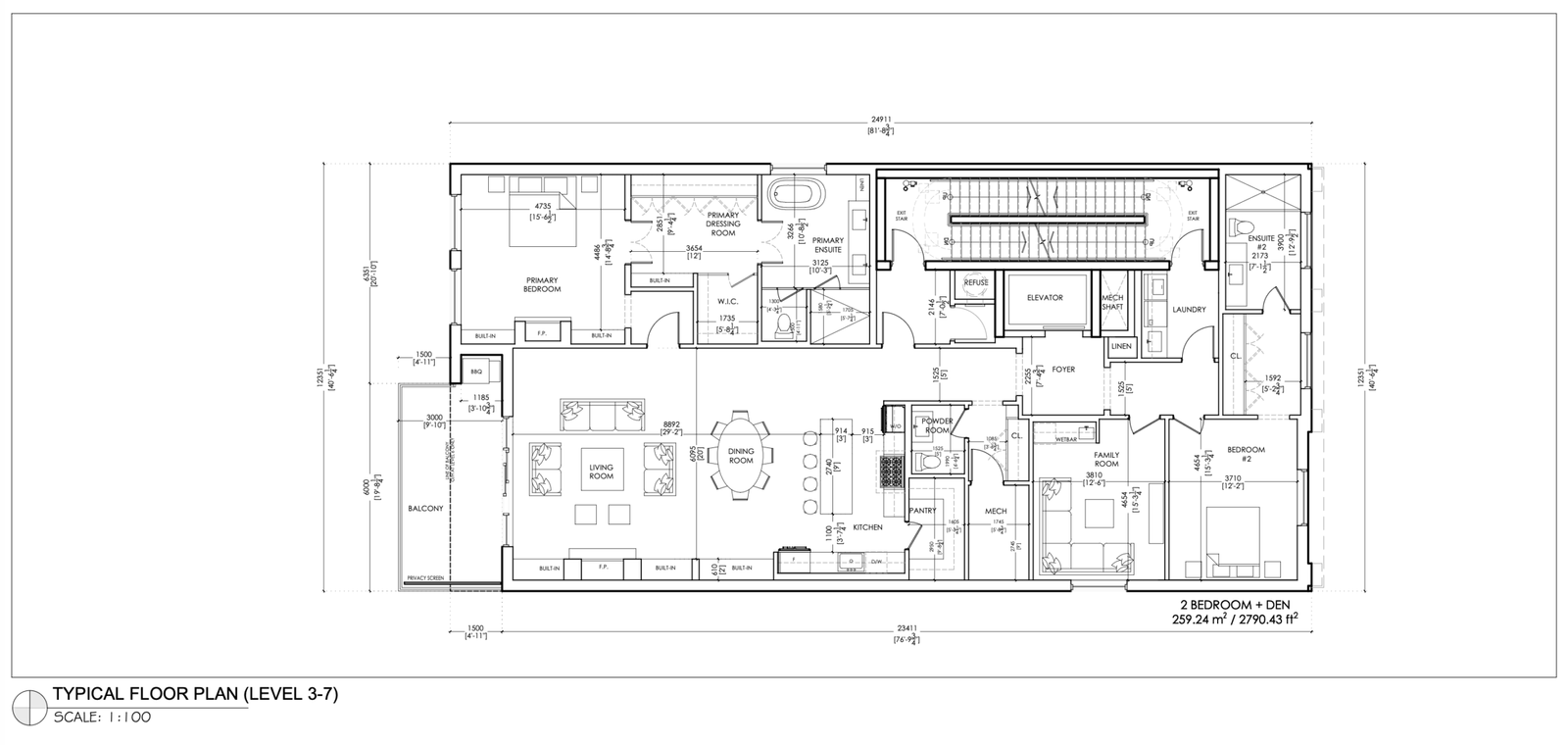
The minor variance application is for a new eight-storey building with 6 residential units, 1 surface visitor parking space, 6 long-term bicycle spaces, and 12 parking spaces in two underground levels (accessed via a parking elevator). This description alone should tell you the target audience, but here’s the typical floor plan:

The fact that this 2,790-square-foot plan only has two bedrooms tells you that this is geared toward wealthy empty-nesters (although the family room could very easily be converted to a third bedroom). So the project is effectively a stack of single-family houses, each with two parking spaces.

This is a segment of the Toronto condominium market that has proven to be the most resilient in the current environment, but who knows how deep that demand goes. Whatever the case, it does feel appropriate for this submarket.

I’m not suggesting that this kind of unit mix should be aspired to everywhere, but this overall scale of housing is something we should be replicating all across Toronto’s major streets and avenues.

That we’re starting to see more of it feels like a maturation of the Toronto market, or perhaps it’s just a sign that larger projects are significantly harder to underwrite today.

The recurring promise and resistance of prefab housing

  • Construction
  • Housing
  • 22 parkside

It’s important to always remember that the idea of prefabricated housing has been around for a very long time, and yet its history is perhaps best described as a recurring cycle of revolutionary promise versus structural resistance.

Some markets, such as Sweden and Japan, have managed to find success, with the majority of their low-rise housing now industrialized or at least involving factory-made components. But in many, or most, other markets, the prefab landscape remains checkered with bankruptcies.

I was reminded of this when I watched this video about the 22 Parkside house in London by Richard and Su Rogers. Originally designed in 1967 for Richard’s parents, the house used prefabricated elements, such as simple steel frames and bus windows, with the hope that it might serve as a solution to Britain’s housing crisis.

Richard jokes in the video that it never happened, but it remains a seminal modernist house nonetheless. (I love the yellow frames.) This problem is not as easy to solve as it may seem, because it’s not just a design and engineering problem.

Cover image for The $1.3M house built on a leftover triangle

The $1.3M house built on a leftover triangle

  • Toronto
  • Real estate
  • Blogto

blogTO just wrote about 61 Seaton Street, which is a house on an atypical triangular lot in downtown Toronto and is on the market right now for $1,329,000. The story goes that this lot sat vacant for decades before architect Paul Reuber bought it in the late 1990s and took on Toronto’s zoning by-law to build what you see here. My rough estimate is that the lot is around 115 square metres, which isn’t that small, but it is a triangle:

I love these kinds of irregular sites because they force creativity and offer a way to unlock hidden value. Our cities are full of neglected micro-parcels, but they often go undeveloped because of land-use policies or because the economics don’t work. Yet small or irregular sites are part of what gives cities their character. If any of you have an oddball parcel of land that has been sitting vacant for decades, drop me an email.


Parcel map from the City of Toronto

Subscribe to Brandon Donnelly

Daily insights for city builders. Published since 2013 by Toronto-based real estate developer Brandon Donnelly.