I like this analogy from economist Justin Wolfers. Politicians are employees of the people. We are the bosses. And like with any boss, it’s impossible to know what our employees are doing all the time. But in democratic societies we have the free press, which helps us keep tabs on them.
If our employees aren’t performing, we can then decide to fire them by voting them out. This is, of course, good for general business because bosses need to know if their people aren’t performing. You can’t manage what you don’t measure, and if the bosses aren’t managing, markets will price that in.
I’m astonished that these are analogies that need to be put forward today in the context of the US, but it’s the unfortunate reality of the current administration.
When developers build new, for-sale housing, they are incentivized to sell that housing. That’s the business. If developers are sitting on unsold inventory — there’s an estimated 4,000 newly-completed unsold condominiums in the Vancouver region — it’s typically indicative of market conditions; meaning developers are sitting on inventory because they have no other choice, not holding inventory because they’re trying to price gouge.
Last week, BC Premier David Eby announced that, if re-elected, his government would impose a new 2% tax on recently completed condominiums if they sit empty for more than 1 year. This would be levied against the assessed value of the property and increase by 1% for each additional year. So, by year three, the tax would be 3%.
This would be a punitive tax that seems to suggest developers are not already incentivized to sell their housing inventory. Eby positioned the tax as a way to encourage developers to further lower their prices and sell homes at price points that people are willing to pay. While it would certainly be a “stick” for developers, why punish home builders? That’s less than optimal for long-term housing supply.
A valuable indicator of current market conditions can be found in Ontario’s new enhanced HST rebate. It represents a meaningful cost reduction on the price of new housing and all signs point to this rebate being passed through to purchasers at or close to 100% of the value. It’s a sign that developers are not looking to price gouge. They’re trying to balance competing objectives and ultimately move their inventory.
Early on in my career, I used to run development pro formas where I would assume that our costs would increase at some rate in and around inflation. Combined with a conservative contingency allowance, I used to think I was being prudent. How cute.
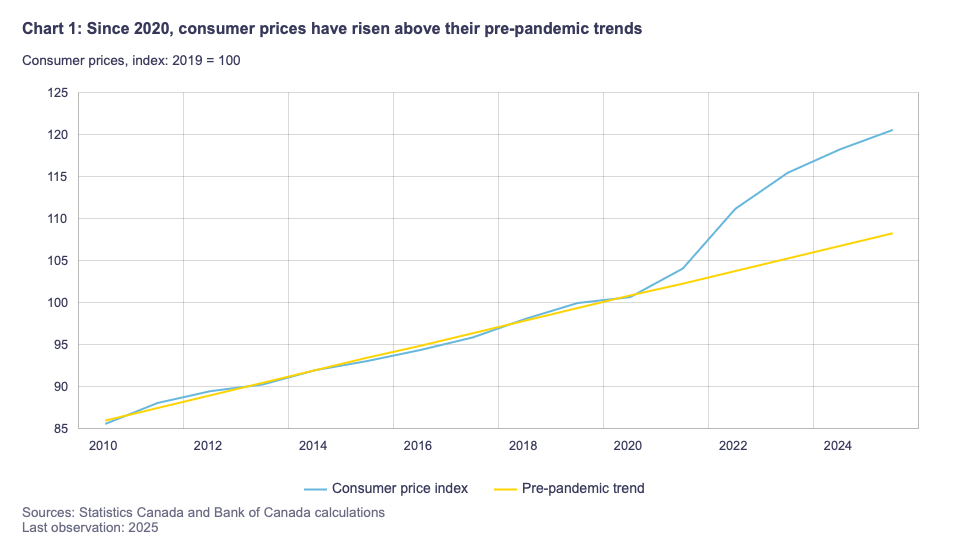
The pandemic made this approach seem silly. Our pro formas did not contemplate 40-50% cost increases for certain line items. But even without these outliers, the pandemic did cause things to become more expensive than one would have expected from pre-pandemic trends. Here’s a recent chart via the Bank of Canada:
But the cost of things is only one side of the equation. For things to be “more expensive,” we also need to look at their relationship to income, and that’s what Yaz Terajima has done here. Interestingly enough, household disposable income seems to have kept pace with the additional cost of things, at least on average.
Between 2020-25, the average household spent about $6,500 more per year relative to pre-pandemic trends, but disposable income increased by about $7,400, creating a positive income-expense gap of about $900.
So why, then, does it feel like things are more expensive? Well, for one thing, there is a meaningful difference across age groups and income levels. Yaz also found that younger and lower-income households did not, in fact, see their incomes rise sufficiently to cover these higher costs.
On top of this, this study does not factor increases in overall wealth due to assets appreciating, which tend to be more concentrated among wealthier households. So the full-picture reality is almost certainly a bigger socioeconomic divide across age groups and income levels.
Subscribe to Brandon Donnelly
Daily insights for city builders. Published since 2013 by Toronto-based real estate developer Brandon Donnelly.