Start typing to search this publication.
Brandon Donnelly logo Brandon Donnelly
Open menu
Brandon Donnelly logo

Subscribe to Brandon Donnelly

Get new posts delivered straight to your inbox.

Brandon Donnelly — Daily insights for city builders. Published since 2013 by Toronto-based real estate developer Brandon Donnelly. — Page 19

The gravity of bond yields

  • Economics
  • Finance
  • Bond yields

Customarily, the “risk-free rate” is considered to be the yield generated by a stable government’s debt. This matters to real estate investors because if you’re going to make an investment and take on additional risk, then you need to be compensated for that risk — earn a spread — above the risk-free rate.

Bond yields are also similarly the foundational benchmark for lots of financial instruments, meaning that when yields go up, so does the cost of other things, like mortgages and real estate debt.

As of August 17, the yield on the 30-year US treasury bond closed at over 5.3%. This was a 19-year high. Howard Marks of Oaktree Capital wrote a great memo on the topic that, as always, is worth a read. Among the factors contributing to higher bond yields, he calls out inflation being “stubbornly higher than is desirable” and the US’s “total lack of fiscal discipline.”

The point of his memo is to once again argue that we cannot repeal the laws of economics without there being consequences. He quotes investor Stanley Druckenmiller who said, “Every basis point of artificial yield suppression is a subsidy to procrastination. Governments defending prices against fundamentals always lose. The only variable is how much they spend before conceding.”

Marks ultimately concludes: “I don’t think the U.S. can perpetually spend more than it takes in and not expect its creditworthiness to be questioned and its IOUs – its currency and Treasury securities – to be disrespected.”

All of this suggests that real estate investors might want to be prepared for “higher for longer” financing costs. That means don’t count on cap rate compression.

Cover image for How tax policy shapes the immigration equation

How tax policy shapes the immigration equation

  • Economics
  • Financial times
  • France

Immigration is an exciting topic (to put it one way). Over the last few years, public sentiment around it has shifted significantly in Canada from viewing it as a positive thing to thinking there’s too much of it.

But as John Burn-Murdoch points out in this recent FT article about the real fiscal costs of immigration, it’s important to be precise about what’s going on. Our decisions and policies guide assimilation and affect whether an immigrant becomes a net cost or net contributor.

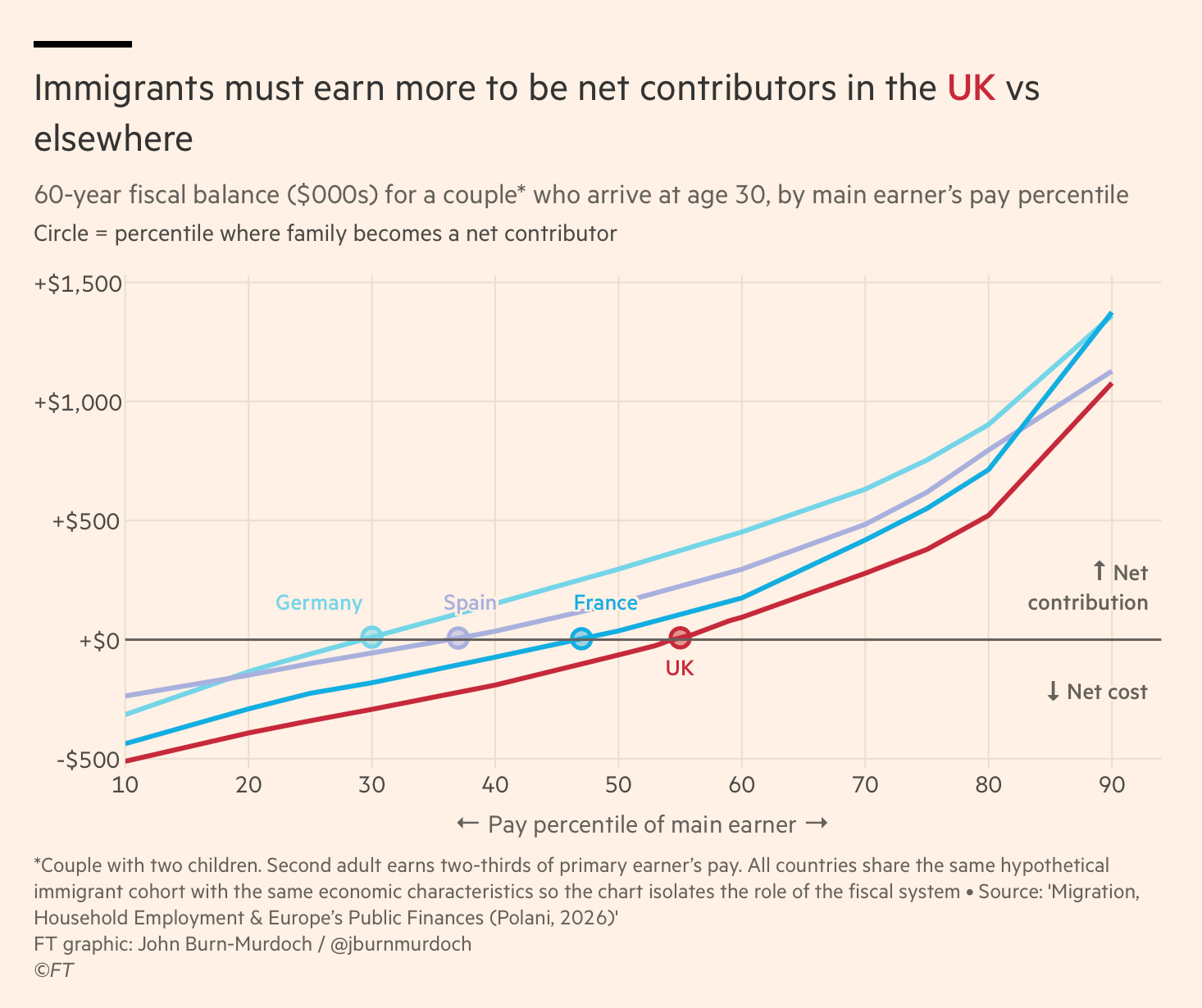
Here, for example, is an interesting chart showing what pay percentile a primary earner needs to reach in order to become a net contributor to the country:

In the UK, the average couple arriving at age 30 needs the primary earner to have a salary at the 55th percentile, compared to only the 28th percentile in Germany. This is because of the relatively low tax rates for low-income workers in the UK, and flatter tax regimes in the other countries in the chart.

This is just one example demonstrating that “immigration,” to use the words of Burn-Murdoch, is “not a fixed thing across time and place.” Who are we attracting? And what policies do we have in place to ensure people economically assimilate and become net contributors?

Cover image for How built form (not more lanes) solves traffic congestion

How built form (not more lanes) solves traffic congestion

  • Mobility
  • Biking
  • Cycling

I snapped this photo while we were in Paris a few weeks ago. We were walking down the street in the 7th and I noticed this mother (I’m presuming) picking up her daughter from the library. The daughter (I’m also presuming) got on the back of the bike and then they took off down the street. She also happened to be wearing a beret, which only added to the whole experience.

When I posted this photo on Twitter, I got some of the comments I would expect. Some people called the mother (we’re all presuming) irresponsible for not wearing a helmet and for not forcing her passenger to wear one as well. Okay, maybe the child is of the age where one is technically required. But another way to look at it might be that it’s a testament to how safe they feel on the roads of Paris.

My implied point was that this could have been a minivan ride. The solution to traffic congestion is not optimizing around the car; it is getting people out of them. Paris proper has about 2 million people compared to Toronto’s 3 million. But the footprint of the former is about one-sixth the land area, making it, on average, about 4 times more dense. And yet, Paris feels counterintuitively less congested, and easier to get around.

The answer, and solution for all cities looking to get people moving, lies in its built form, its rail network, and what you see pictured above.

Subscribe to Brandon Donnelly

Daily insights for city builders. Published since 2013 by Toronto-based real estate developer Brandon Donnelly.