
 Thought Crime Trap House
Picasso Network: Connecting The Unconnectable
Composable Finance's Picasso Network is attempting to make Solana IBC compatible.
 Thought Crime Trap House
Why The Unique Experiences On Farcaster Retained Me As A User
Can we leverage these experiences to grow Farcaster?
 Thought Crime Trap House
Fight For Your Right To Use Bitcoin As It Was Intended To Be Used
We may have won the battle, but the war for financial freedom is not over, here's how you can help.
Opt out, escape the surveillance state, and live free with me outside of the system.
 Thought Crime Trap House
Picasso Network: Connecting The Unconnectable
Composable Finance's Picasso Network is attempting to make Solana IBC compatible.
Thought Crime Trap HouseWhy The Unique Experiences On Farcaster Retained Me As A User
Can we leverage these experiences to grow Farcaster?
Thought Crime Trap HouseFight For Your Right To Use Bitcoin As It Was Intended To Be Used
We may have won the battle, but the war for financial freedom is not over, here's how you can help.
Opt out, escape the surveillance state, and live free with me outside of the system.
Share Dialog
Share Dialog

Subscribe to Thought Crime Trap House
Subscribe to Thought Crime Trap House
Welcome to the Thought Crime Trap House, no recording devices, snitches, or bootlickers allowed. I am the one and only Thoughtcrimeboss. Why should you listen to me? Well I have lived outside of the "system" for more than a decade now. In all practical terms, I don't exist, and I have learned a few things along the way that I can teach you.
You don't have to go to the extremes I have, but protecting your privacy is no longer optional. Criminals are getting data on crypto holders from data leaks and targeting them with kidnappings and armed home invasions. The state is implementing an AI powered mass surveillance network on a scale never before seen in history. Digital IDs and CBDCs are spreading like wild fire and the exits are closing. If you don't opt out and build a life outside of the system soon, you might be trapped in it forever. Subscribe to get the latest news on crypto, freedom tech, and privacy alongside actionable advice to help you opt out and protect yourself.
In this issue:
Avoiding online age verification and potential workarounds if you encounter it
Testing the new Monero/HyperEVM bridge
Do any of the zero KYC prepaid virtual debit cards work?
The ZEC governance drama
and more!
If you want to support me and my mission to help people protect their privacy and opt out of the system, please consider donating some crypto to the cause. Please excuse my bad language and rampant sarcasm.
Send some ETH or any ERC-20 token on mainnet or any EVM layer 2 blockchain to thoughtcrimeboss.eth
Send me sats via Bitcoin mainnet: bc1qlewp9p426pe3t70fdwx0sg84dfqhnwae20unc5
Or send me Bitcoin via lighting to burnedmitten671@minibits.cash
Send me SOL or any Solana token at 9uLhcY5AKHjYK3kySrgDnWqp5NFh9p1LQztT8iZUPdxZ
If you want to send me any other crypto currency, I don't care what it is, just comment or message me what blockchain you would like to use and I will gladly spin up a wallet and give you the address.
You can also support me by following me on Nostr npub1uqxkqdq3xngndgwlck03hje0u25uu7ql9nakh63yjk2m63thczkszeffca
Or follow me on X and help me get to 1k followers!
Please share this with your friends and enemies, it's free and it helps me a lot.
Before we get to the news, I wanted to share my thoughts on and my personal experience with the latest threat from the surveillance state, online age verification, a threat that most people seem to be ignoring.
Online age verification laws are spreading like a plague across the world right now. In the United States for example, there were no such laws in 2022. Now, there are 25 states with a law on the books. Sold to the public as a means of "protecting children" from the evils of porn and social media, these laws have faced little opposition so far. I don't know why it is so popular these days to outsource parental responsibilities to the state. If you don't want your kids to watch porn or use social media, there are a million ways to do that without involving the state and imposing restrictions on adults.
I don't think these laws are really about protecting kids, it's just a sneaky way to lock down the internet. The freedom to be anonymous on a free and open internet is something that gives people power and takes power away from the state. Information and media used to be almost entirely controlled by the ruling class until we got widespread access to the internet, and everything changed. Now independent media is more popular than mainstream media, when before the internet independent media barely existed beyond maybe a few pirate radio stations, mail order publishing companies, and xeroxed zines with limited reach.
This is also the first step to a widespread "digital ID" that they will want you to use to be able to access the internet at all. If we allow this to happen, anonymity on the internet will disappear and every single thing you do will be tracked and recorded. This will stifle free speech, people will be scared to express controversial ideas and opinions if they know they will be linked directly to their identity. The internet as we know it will change forever and not for the better.
Beyond the false "protect the children" narrative, I know some people will also argue that we need some form of digital ID/verification to combat the proliferation of bots on the internet. That's simply not true. There are a myriad of ways to verify humanity and uniqueness without the need to verify identity.
Age verification was definitely a threat on my radar for awhile now, but it was always something to worry about tomorrow. That changed the other day for me when I tried to download Session, an encrypted messaging application on one of my normie phones (as in, not degoogled). Google informed me I would not be allowed to download this app from the play store until I verified my age. Although I knew I would probably encounter this eventually, once it was actually in front of me, it still made me very angry. I have been using the free and open internet since the dotcom bubble started and this new thing felt so wrong. I felt violated just looking at those words, "Verify your age". I mean I didn't even like the ol' "check this box if you are over 18", but at least it wasn't invasive.
Now the question that immediately came up for me, is why the fuck does Google think I am a minor? What did I do to trigger this? My theory is that I logged into the account from a Malaysian VPN server too many times and unbeknownst to me, Malaysia has made it illegal for those under the age of 16 to use social media. I guess Google considers Session to be a social media application.
Out of curiosity I clicked through to see what the options for age verification were.

The options included a selfie, scanning your ID, using your credit card, or using some third party service that does something with whatever email address you give it to determine if it thinks you are an adult or not. I am not going to show Google my face, so that eliminates selfie as an option, although not entirely because I could show Google someone else's face. The idea of paying a hard drug user 10 bucks to take a selfie for you is a good option to keep in one's back pocket if this bullshit becomes more widespread, but then you do risk linking your account to someone you may not necessarily want associated with it. The selfie method is supposed to just determine if you're an adult and then permanently delete the selfie, but you are trusting them to actually do that. This isn't open source tech, so there is no way for the user to determine if the image was actually deleted, of if it gets saved in a database somewhere. I want someone to try it with a mannequin or a picture to see how accurate it is, if anyone has done this please let me know.
Scanning my ID is also not an option, for one the ID wouldn't match the name on the account, and my ID has been expired for years which could probably be an issue when doing an ID verification, although I'm not sure. I already don't trust Google not to save a selfie, so I certainly don't trust them not to save all the information on an ID. Google doesn't need to know what my government name is. I also don't have any credit cards under the random alias name I gave to Google, so that also wouldn't work unless it would accept a prepaid debit gift card, which is possible. Maybe I can spin up a new Kemycard for this purpose and see if it works. (See the end of this issue for more about no kyc virtual prepaid debit cards)
So the only option I could try right away was the email address scanning, which I already knew wasn't going to work, because the only email address I was willing to use for this to avoid unnecessary linkages was the Gmail address associated with the Google account I was trying to age verify. It doesn't read your emails (well, they might with a Gmail address, who knows); it just looks at how old the email address is and what kind of accounts it is associated with. That Gmail address has had very little usage for anything, so I didn't expect the algorithm to decide it was enough to determine my adulthood. I was correct, it failed, and I proceeded to side load Session and bypassed the Play Store entirely.
It's great that I know how to side load apps and am willing to do so to get around this, but the average person is just going to comply because they want to have access to these age restricted apps. Google is going to have the ability to know exactly who owns every single Google account if we don't stop this age verification nonsense.
Google should just look at my app store downloads and check if Tik Tok, Instagram, or Snapchat are on my device. Since none are present, it should be plainly obvious that I'm either not a teenager or I am a very weird teenager with no friends.
Now age verification laws vary widely across jurisdictions, and this is doxxing me a bit but I don't currently live in a location with an age verification law that would even apply to Session. Session is not a porn app, it is not a gambling app, it is just a way to send private messages. To restrict this for minors is the same as telling them they can't talk to anyone privately. It's retarded. Kids will find a way around it because that is just what kids do. Also, a teenager is just as entitled to use encryption as any adult. In fact they should be encouraged to do so, the earlier a child learns the importance of protecting their privacy from corporations and the state, the less data will be harvested from them before they have a chance to stop it.
Also, I don't know how kids are these days, but when I was a young teenager the more rules and restrictions you threw at me, the harder I rebelled. I feel like that is true with a lot of teens, and doing dumb shit like banning them from the internet is probably going to backfire. You just know if you take away all their toys, some kid is just going to vibe code his own social network and say fuck y'all.
How to avoid getting flagged for Age Verification in the first place
The best option is to avoid Google altogether, get a Google Pixel phone and install Graphene OS to use Android without a Google account. Most apps will work on Graphene OS, and this will improve your privacy dramatically. Although Google might change Android one day to make it impossible for Graphene OS to update to the latest version of Android, and in that case you might want to still have an "adult" Google account lying around. If you don't want to buy a Pixel and don't own one already, there are alternative degoogled operating systems that are compatible with non pixel phones, such as Calyx OS. I haven't tried them yet, DYOR.
Do not get your account associated with any age verification jurisdictions. If you travel to one or live in one, make sure you have your VPN on and set to a server in a non age verification jurisdiction. If you don't live in such a jurisdiction, remember not to use any VPN servers that are in one.
Don't watch a bunch of videos on Youtube that might be popular with teenagers, such as gaming content or ...I actually have no idea what is popular with teenagers these days? Maybe videos on changing your gender identity?
You shouldn't be using Google for searches in the first place but if you do don't search for anything that a teenager would be likely to search for. If you don't use Google search, start throwing an occasional fake "adult" search out there such as "how to tell your kids that their mother is a whore" or "how to keep my prostate healthy". I don't know. Be creative.
Do random 'adulty' stuff? Apparently having new or "low activity" accounts can also get you flagged.
Potential workarounds if your account does get flagged
Some people have said if they just ignore it, the system unflagged them. This is what I am hoping happens to me now that I am no longer logging in from Malaysia.
Use someone else's face for the selfie. This is iffy, because this still can create a link to you so make sure it is someone who doesn't know you or your name, like a random homeless person. If they don't ever use the internet, that's even better. Yes people like that still exist, and they are probably going to become increasingly valuable in our new world.
Prepaid debit gift card. You can get these a number of ways, most grocery stores in the United States have them in the gift card section, look at the packaging and the Visa ones that have a registration website called "giftcardmall" work well. Theoretically, in Minecraft, you could register them on public WiFi without a VPN to avoid being flagged, and just use the name on the Google account that you want to verify the age of. Sometimes you can use a homeless shelter address for the address or a random house for sale. Now I am assuming shotgun KYC is a possibility with these cards because the fine print on the bottom of the registration page says they can ask you for your DOB and/or identity documents. Though I have used these cards many times and have never been asked for more than a phone number and email address. If you don't even want to give up a phone number or name to the debit card company, you can also use USDC to buy a prepaid virtual debit card like a Kemycard with no KYC at all and attempt to use that. (More info on these at end of issue) I don't know if it would work for this because there would be no name attached to it, just a billing address. Google just charges a small amount (less than a dollar) to the card to make sure it is valid, so you wouldn't have to put a bunch of money on it. Make sure the USDC you use to buy it isn't linked to your real identity or it defeats the entire purpose.
If you happen to have an email with some history that you don't mind associating with your Google account, that may be the easiest way to convince Google you are an adult. WARNING: You get ONE shot at this per account. If it fails, they don't let you try again with a different email, the option just disappears off the list.
Just make a new Google account from a non age verification jurisdiction VPN server, and start seeding it with those "adult" style searches we talked about above.
Bypass the Play Store entirely by side loading any restricted applications by using F Droid or downloading APK files directly. Now remember,
There is no universe in which these age verification laws are good for society, they are just another way for the state to restrict access to the internet and the free flow of information which is a threat to the ruling class. Resist and avoid complying as much as you can.
To find out which states have age verification laws and how strict they are, check this site:
https://action.freespeechcoalition.com/age-verification-resources/state-avs-laws/
Here is a list of countries with age verification laws :
https://en.wikipedia.org/wiki/Social_media_age_verification_laws_by_country
A Federal Judge just blocked the law in Texas that required you to verify your age to download any app, it didn't matter what kind of app it was. The judge rightfully pointed out that this was about as retarded as IDing people at the entrance to a bookstore.
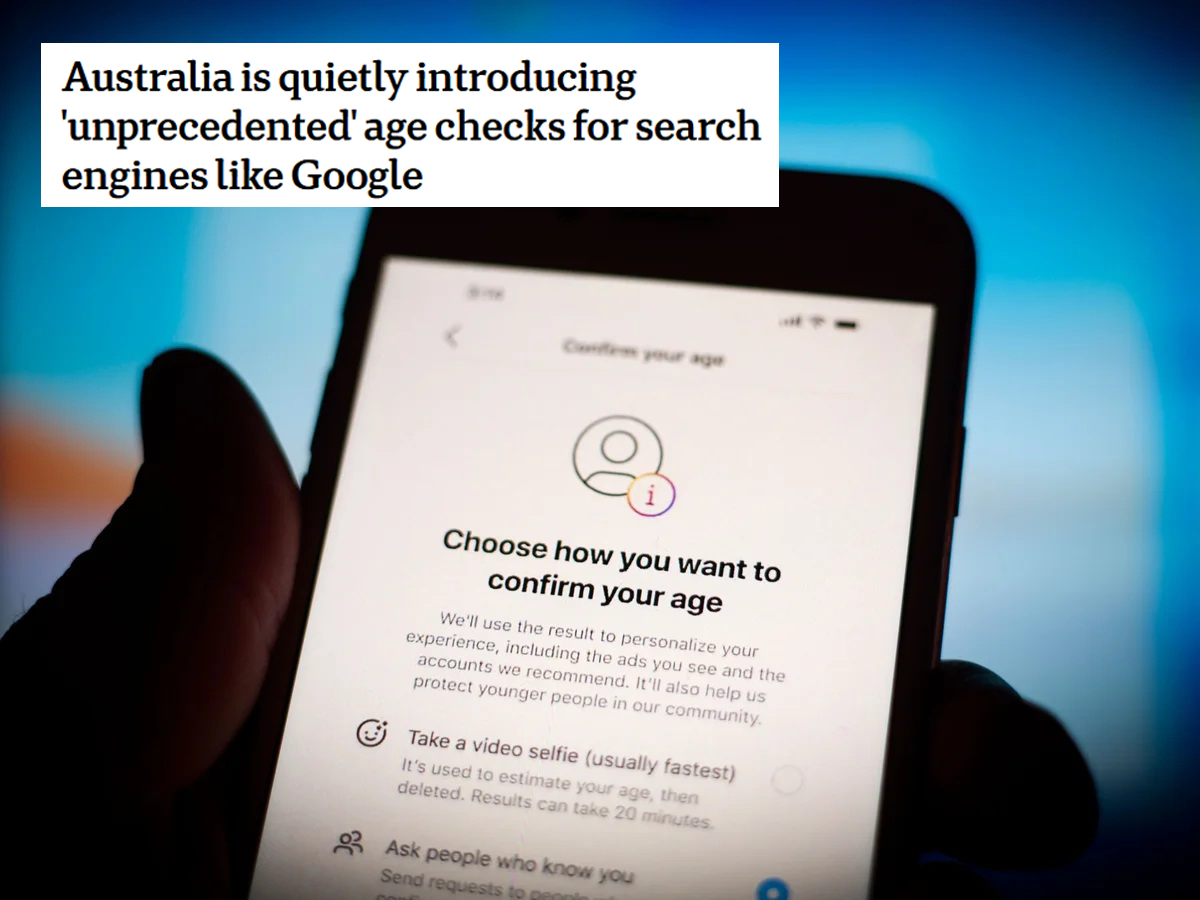
You now have to upload ID just to use Google in Australia
Supposedly this guy went to Walmart with no devices on him, bought a phone charger with cash, and still got tracked. I'm assuming this means Walmart is tracking purchases using facial recognition, which isn't surprising. Someone needs to repeat this experiment wearing reflectacles (anti facial recognition sunglasses) and a hat, and see if this still happens. That's a good idea for a POIDH social bounty....
 AN ATTORNEY PAID CASH AT WALMART WITH NO PHONE - AND THEY STILL KNEW EXACTLY WHAT HE BOUGHT
The UK is continuing on it's descent into an Orwellian dystopian state, although America is not that far behind.

Another one bites the dust.

Virginia’s push to police teen screen time edges the internet closer to an era where every click comes with an ID check.
Last July, Wilmer Chavarria, a U.S. citizen and school superintendent, was detained by Customs and Border Protection (CBP) gestapo agents in Houston for over four hours without any evidence of a crime or probable cause. He was isolated, denied access to his lawyer and family, and harassed until he finally gave in and handed over his smartphone, tablet, and laptop. Honestly, I am impressed he lasted as many hours as he did, most people just comply immediately, which is one of the reasons why our rights are deteriorating so rapidly. They lied to him and said he had no Fourth Amendment rights at the border. Your rights don't help you when a gang of armed thugs who don't give a shit about those rights have you locked in a room.
These agents were using the ridiculous concept of the "border exception" to the 4th Amendment. The government claims the Constitution doesn't apply within 100 miles of the border—a zone that includes two-thirds of the U.S. population. They think they can go through your texts, your photos, your medical history, your work files—without a warrant or even suspicion of a crime. These warrant-less device searches by CBP have quintupled since 2015, and they are copying the data and storing it in a government database for 15 years. Chavarria described the experience as being abducted by a violent gang, which is exactly what it was. He's now afraid to visit his own mother because he doesn't want to be detained or disappeared, but he is fighting back at least and suing these bastards.
There are now incidents of US citizens being snatched up off the street by masked men and having their face scanned without consent. This is literally a scene in every dystopian movie and TV show ever, the anonymous government agents rolling around town scanning and kidnapping people for no reason.
I don't care what you think about illegal immigrants, but there is no way you should be able to justify snatching CITIZENS up off the street with no evidence of a crime, no probable cause, no reasonable suspicion. The only thing that these agents are using is whether or not you "look" like a citizen. Given that there is no uniform visual appearance of US citizens, this is vast government overreach disguised as immigration enforcement.
If you want to avoid being kidnapped and having your face scanned by the Gestapo, I recommend that you look like a white person. Other than that I have no clue. Anti facial recognition sunglasses aren't going to help us when the Feds just rip them off our faces in the back of an SUV and scan us anyways. THIS SHIT IS GETTING CRAZY.
You know all those conspiracy theories about the WEF and globalists forcing everyone to use digital IDs and CBDCs, so they can track and control the entire world population? Well it's happening, and it's happening right fucking now. If you don't exit the system like I have soon, you might not ever be able to exit the system. I mean once they get your biometrics or DNA and link it to a digital ID, you are stuck bro. Get the fuck out NOW.

Well Bitcoin ended the year with it's ass kicked by precious metals and the stock market, which is probably not what you were expecting to happen in the first year of a "Bitcoin President". Well turns out we didn't actually get a Bitcoin president but more like a "Max Extracting Memecoin Launching Shitcoin President". Now I find myself having to explain to random liberal normies why crypto isn't bad just because Trump likes it. So far the only crypto legislation that has passed was the Genius Act which basically protects incumbents in the stablecoin space and turns them into backdoor CBDCs. Don't lose faith yet though, this year also saw the rise of privacy coins as a narrative and Monero and Zcash outperformed the rest of crypto. At the same time that Bitcoin is becoming institutionalized and sanitized, crypto is returning to it's roots as freedom tech. I'm hoping the privacy meta holds up in 2026 and that more people get turned on to financial privacy. I think people have realized that most cryptocurrencies have zero actual value or utility and are looking for the few that do. I remember when I first came to this realization, it was tough to swallow that most coins were just memecoins, with some governance rights if you are lucky. We have to thank Federal Securities Laws for making most of our coins completely fucking useless. If it wasn't for the state, the entire world would probably be using crypto by now. Their laws prevented none of the scams, but did prevent lots of innovation. I still have hope for the future though, crypto isn't going anywhere, and even the state can't stop an idea whose time has come.
More from Nic Carter about the Quantum threat to Bitcoin, this post is an easier read than his original 2 part series if you just want a quick overview of why some people are concerned about this.

Why a cryptographically-relevant quantum computer undermines Bitcoin, and why I think it's likely one emerges in the next decade
MTG on why she voted no on the backdoor CBDC bill, aka the GENIUS Act.
In the UK you now have to get permission to withdraw any cash at all now and tell your bank the purpose for the cash.

Wallet of Satoshi, a custodial mobile Bitcoin lightning wallet, is shutting down in the EU due to new regulations. This is yet another example of why custodial solutions shouldn't be relied on to scale Bitcoin, since they can just get shut down by the state easily.
 NEW: WALLET OF SATOSHI WINDS DOWN CUSTODIAL SERVICE IN EU

A little known tax-law that went into effect on January 1st is pushing custodial services out of the EU.
Ledger leaked customer information AGAIN. Don't order hardware wallets to your house or even in your name if you would like to avoid 5 dollar wrench attacks in the future.

XMR perps and even spot have been deployed on Hyperliquid, well kind of. Hyperliquid is an open protocol and anyone can deploy a perpetual futures contract based on any asset onto it. These perps are based on a token, XMR1, which is pegged to XMR's price because XMR1 is exchangeable for real XMR through a platform called Wagyu.
Wagyu also happens to have an airdrop points program...so I decided I had to test this process out and if it worked I might start doing my XMR DCA purchases through it. I'm only buying small amounts anyways, and I am getting fucked for fees and slippage on the various "instant" crypto to crypto swap services that are the primary means of acquiring XMR without using a KYCed CEX.
I wanted to see if I could get a better price through Wagyu, which is also my favorite food. I have no idea what kind of security guarantees this dev has set up for his or her little bridge, if any, so I would not stick your life savings into this! Make small purchases only until we know more. This is the first time I have personally seen any XMR token living on another blockchain since sXMR on Secret Network years ago. sXMR was a wrapped version of XMR and there was a working Monero to Secret Network bridge for awhile, it might even still exist. Now that was cool because Secret Network was also a private blockchain (or was supposed to be private anyways), so you could use your XMR in DeFi on Secret Network without having to give up your privacy. Unfortunately, Secret Network didn't really catch on and is pretty much a dead chain with very little liquidity at this point. So now people are trying once again to get Monero onto other blockchains, or at least Monero derivatives.


The risks:
Counterparty risk. Right now when you bridge in or out using wagyu.xyz , this random "Perpetual Cow" developer is your counter party risk. He or she doesn't exactly have much trust built up, because they just created their X account in December. But to be fair, if I was building a Monero bridge, I would be anon and using a fresh X account as well.
Depeg risk. You aren't buying actual Monero on Hyperliquid, you are buying XMR1, so you have the risk of it potentially depegging from the XMR price before you can bridge out. Although bridging was pretty fast, so your funds aren't at risk for long.
At first I thought I could just go on Hyperliquid's main front end and do this, but you can't. For whatever reason, currently you can trade the XMR1 perps on the main front end, but you can't trade XMR1 spot on that site. You can use the perps if you want to trade XMR with some leverage, but currently this is only good for very short term trading, short trades, or funding arbitrage trading because the funding rate is consistentally very high and positive.
So what I found out was that you have to go to a different front end at usefelix (NOT ANYMORE, SEE UPDATE AT END) to trade the XMR1/USDC spot pair. So I got some USDC and a little HYPE for gas fees and went to work to see if I could turn USDC on HyperEVM into fake "XMR1" and then eventually real XMR in my Monero wallet, without KYC or permission from anyone.
I ran into problems almost immediately. I started trying to place a limit order to buy $15.19 worth of XMR1. It bought me $13.29 worth even though there was supposedly plenty of liquidity at my order price according to the UI. You can't place an order for only $1.90, so to avoid getting stuck with change I sold the XMR and tried again.
This time I tried a market order which theoretically should have filled the entire order amount at whatever price it could get, but instead it only bought $4.48 worth. So I now had like $10.67, and on the main Hyperliquid frontend the minimum order size was $10. So I just kept clicking order to try and market buy the remaining XMR1. It would just say order processing, and then nothing would happen. There was no helpful error message, no pop up, no nothing except frustration. Interestingly the price in the UI didn't change the entire time I was doing this, the bid was 442 and the ask was 443 for like twenty minutes. Volume was so thin that my trades had been the only ones to occur in a little while. This shouldn't of mattered though, because there was liquidity available in the order book.

I tried limit orders as well and the same thing would happen. So I assumed it was something wrong on my end. I refreshed, cleared my cache, restarted my computer, and did all the things you do when a website isn't working properly. No matter what I did, I couldn't buy $10.67 worth of XMR1!
I guess I should of kept the original $13 worth of XMR1, because now I only had $4.48 in XMR1 and it would not let me buy any more. I had no idea why. So I decided to try bridging what I had managed to get out.
Turns out the minimum for bridging out is 0.01 XMR1, and of course I had 0.00998.
GOD FUCK SHIT! I just wanted some content for my newsletter and some airdrop points for fuck's sake. Why does the universe hate me?
After smashing buy on both market and limit orders repeatedly out of frustration for a while, I finally looked in order history and it said "minTradeNtlRejected", so I guess the minimum isn't $10 but higher? Unfortunately I couldn't sell the 0.00998 XMR back into USDC to get enough for the minimum order, so I had to deposit more USDC.
So I deposited more for the final final test and this is where things got even MORE super fucking confusing. At the time I deposited more USDC, I still had the 0.00998 XMR1. I lined up an order for 17.57 USDC and it said I was supposed to get 0.04 XMR1 for that. I compared this to a quote from the instant swap aggregator Trocador at the same time. Trocador's best price would have gotten me approximately 0.03869 XMR, which is 3.275% less. So I smashed buy, the order processed, and I should now have 0 USDC and 0.04 XMR1 in addition to the 0.00998 XMR1 I already had, right?
WRONG.
Wait...why the fuck did I now have 4.29 USDC and 0.04 XMR?
WHAT IN THE FUCK IS THIS STUPID SHIT? Was I losing my mind...? Even worse, I swear to god it said I had 4.29 USDC after this trade, but later I magically had 3.29 USDC and I have no clue why. Maybe I misread it, it's a possibility. I haven't done a full investigation into the transactions on the block explorer to see yet, because I really don't have any more time to devote to this bullshit.
I don't know why this fucktarded app couldn't handle filling a simple market order in full when there was liquidity. Was this a problem with the frontend or the protocol itself?Maybe these shenanigans is why the XMR1 spot pair is not listed on Hyperliquid's main site.
Or maybe I am just a moron who can't do simple transactions? That is a possibility. Please keep in mind that all of this could just be user error, but at the very least the UI needs to be improved to make it obvious to users why their orders aren't going through or are getting partial fills.
So after my final order, I said fuck the change and tried bridging off what I had managed to acquire. I went to Wagyu and put in my Monero address, and had zero issues. The XMR was transferred from XMR1 to real XMR almost instantly with zero bridge fees. I did have to pay the Monero blockchain's transaction fee, so 0.04 XMR1 was transformed into 0.03995971 real life XMR in my wallet, and it has survived the scrutiny of multiple blockchain confirmations.
Mission success, despite some difficulties I did successfully turn XMR1 on HyperEVM into real XMR on the Monero network using Wagyu. The Wagyu bridge worked great, no problems, but my experience with the usefelix dapp was absolutely horrendous. I have never had that much trouble making a simple market order in my 8 years of using crypto. I have no idea why it keeps splitting these market orders up and not filling the entire amount, because the order book was showing that plenty of liquidity was available. Normally, a market order should just gobble up the full amount at whatever price it can get. I have no idea if this problem would occur with larger orders as well, but be aware of it.

Despite the problems, it's still cool that I was able to buy XMR1 on HyperEVM and turn it into real XMR on Monero. CEX delistings don't really matter if you can just deposit USDC into HyperEVM and purchase XMR without any accounts, KYC, or permission. We need more of these permissionless cross chain bridges for Monero, as the more different ways one can purchase Monero, the better. That's one of the reasons ZEC just had such a wild pump, because of the NEAR Intents integration with Zashi wallet enabling people to buy ZEC using Solana or EVM chains like Base.
I hope that this process becomes easier and the bridge becomes more secure, so that Monero is fully integrated into the Hyperliquid ecosystem. As I am writing this, the XMR1 perps has done $1,786,395 in 24 hour volume with over 5 million in OI. The spot pair has done ...........wait a minute what in the fuck.
UPDATE: I just wrote all this, and I just wanted to check how much volume the XMR1/USDC spot pair did today on usefelix, AND it's gone. The link doesn't work anymore. The usefelix frontend is still up, but the XMR1 spot pair has vanished. And I thought I was done with this little article!
Apparently you now have to go to https://app.based.one/XMR1/USDC to trade this. I have not tested this one out. I hope it works better than usefelix did. Well at least we know the bridge works. I did check defillama to make sure this latest home for XMR1 is legitimate and it seems to be, having done 2.5 billion in 30 day volume across the whole platform and 616k in XMR1 volume in the last 24 hours. I'd spin up an account and shill my referal link but I am so over this, I'll save that for the next issue, if XMR1 still exists by then!

There has been some Zcash drama since the last issue. First there was the trademark incident in which the Zcash Foundation went after a website called Zcash Strategy which as far as I can tell is some kind of small DAT with only $36k in assets. They sent them a cease and desist and threatening legal action against them for trademark infringement if they didn't voluntarily transfer the Zcash Strategy domain to the Zcash Foundation. There was a swift community backlash and the optics of a supposedly "cypherpunk" privacy blockchain doing this was not good. This happened to correspond with a deep pullback in Zcash from it's local high at $744 to a low around $300.

Zcash's price would recover, getting back up into the 500's before pulling back again. The latest pullback was accelerated when there was a surprise announcement from the CEO of the Electric Coin Company, Josh Swihart stating the entire core development team was resigning and forming a new company due to a conflict with the board of Bootstrap which is a different non profit than the Zcash Foundation involved in the trademark drama. Bootstrap was created specifically to oversee the Electric Coin Company, and the devs at ECC have to rely on the board of Bootstrap for funding. Josh Swihart's initial tweet seemed very bearish in it's wording and caused a massive sell off in Zcash as tweets lacking context stating the entire Zcash development team had resigned spread across X like wildfire. In reality it seems like the devs are just ditching their non profit overlords so to speak and continuing Zcash development in a new company so that they can get paid more money.
Josh waited almost a full day before he clarified what this mass resignation actually meant, and the price has recovered somewhat.

DefiIgnas did a good overview from probably a less biased perspective than Mert, if you want to know more check out their thread.

Regardless of whether the final outcome of this drama is bullish or bearish for Zcash, I think it is a good demonstration of the advantages of Monero's pure community based governance model versus Zcash's corporate/nonprofit hybrid model. Maybe it's best to go either all the way community governed like Monero, or just be run by a corporation on the other end of the spectrum instead of trying to straddle the line between the two. There are various legal reasons as well for different governance structures. It frustrates me that onerous government regulations have such a big effect on crypto governance structures. You have to wonder what kind of innovation hasn't been able to happen because people are more concerned with what's legal over what works. You can't blame them for it either, considering the gun in the room so to speak.
However Monero's governance model has proven that a purely community run protocol can still fund itself, grow, and outperform the rest of the market. A corporation or foundation can easily be shut down by the state at any moment, a community can't be. Unlike Zcash, Monero has no dev tax for developers to fight over either.
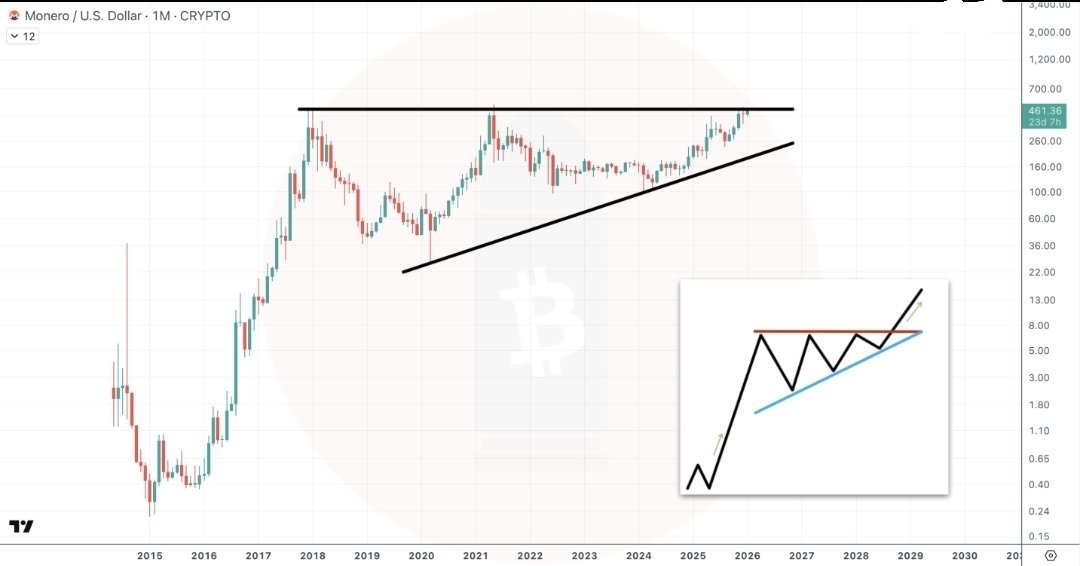
If you need proof that the community model is working, Monero is on the verge of breaking all time highs with one of the best looking charts in crypto right now.


Monero has also resolved it's recent governance dispute, albeit one much less dramatic than the Zcash one. The Monero devs were trying to decide whether or not to put in place a temporary block size limit to prevent issues after the FCMP++ upgrade goes live. The impetus for this was that on the FCMP++ testnet very large blocks (over 100 MB) would break things. This means that theoretically post FCMP++ an adversary could try to spam the network to get the block size big enough to crash the network. Monero has a dynamic block size, so the blocks automatically scale with demand.
Placing any kind of block size limit on Monero was controversial because Monero is meant to be digital cash, which means the ability to scale is important. Unlike Bitcoin which decided to keep blocks small so that poor people in third world countries could afford the storage space to run nodes or something. You have to think, if someone can't afford to buy a slightly bigger hard drive to run a node, they probably are too busy trying to eat to run a node anyways. I never understood the Bitcoin small blocker's arguments and I have to wonder if the community was "influenced" by certain interests that were trying to prevent Bitcoin's adoption as an actual currency in competition with the dollar, which was the original path Bitcoin seemed to be on. Then the small blockers won, the narrative changed from peer to peer digital cash to digital gold, and Monero took on BTC's original mission to become permissionless, uncensorable, and peer to peer digital cash.
Initially a temporary 32 MB "sanity cap" block size limit was proposed, I think that was then raised to 90 MB. After much discussion, the Monero devs came to a consensus, there would be no sanity cap block size limit. Without a block size limit, it would take two to three years of aggressive growth on the network before we would start to see issues with FCMP++, so they should have plenty of time to prepare and find a different solution.
A while back I saw a bunch of tweet threads going around listing various supposed non kyc debit cards you could buy with crypto. I've tried two of them so far, Pay with Moon and Kemycard and have had mixed results.
With Pay with Moon I loaded up one of their digital visa cards using USDC with just enough to pay for a month of X premium. All they provided was the card information, there was no billing address or name attached to it, nor was there a way to register a particular billing address to it. Because of this, I didn't have much faith in it working but it did work for the first payment. I loaded a new card with enough for two months of X premium and that worked for the first month, but when it was time for the second month's payment, X informed me my payment had failed. So I checked Pay with Moon's website and it told me my card had been cancelled with zero explanation as to why it had been cancelled. Instead of a digital Visa card I now had $8 worth of moon credit which I couldn't even withdraw because it was below the $10 minimum to withdraw. A quick search on X revealed that many people had recently gotten their Pay with Moon cards cancelled, so you can file that one in the "doesn't work" category.
Next up was Kemycard, which had much higher fees than Pay with Moon, and the UI was a bit confusing. If you want a card without providing any personal information, you have to select "Basic Card" and it costs $20 in USDC to create one. Unlike Pay With Moon's cards, these Basic Cards are re-loadable digital prepaid VISA cards. After your initial load, if you want to reload it (minimum reload is $5, max is $500), the fee is $1.50 for under $100 or 1.5% for over $100. I was pleased to discover that although there was no name attached to the card, there was a billing address assigned to it which will probably help it work in more places. Some payment processors will reject cards that don't have a registered address, so this is an advantage. I used this card to pay for a subscription to Notesnook and had no problems, however the Pay With Moon card also worked for awhile so I will keep an eye on this to see if it continues to work.

Currently I only use these cards for something like a digital subscription to a service that doesn't accept Monero, although theoretically you might be able to load it into a Google Pay account and use it at a IRL store. If anyone wants to try that out, let me know how it goes. I'm going to slowly increase the usage and see at what point, if any, it triggers a shutdown or a KYC request. If you are experimenting with these cards, start small. Never load more than you're willing to lose to a frozen account. DYOR, all I currently know about this card is that it worked and it provides a billing address, don't put your life savings on it.
I get $5 if you get a Kemycard with my affiliate link and I think you get $5 too, but you have to claim it from an email they will send you after you sign up or it expires. If you prefer not to use my affiliate link here is the regular link.
Thanks for reading, please leave a comment! I would love to know if anyone actually read this. Until next time, stay free my friends.
Welcome to the Thought Crime Trap House, no recording devices, snitches, or bootlickers allowed. I am the one and only Thoughtcrimeboss. Why should you listen to me? Well I have lived outside of the "system" for more than a decade now. In all practical terms, I don't exist, and I have learned a few things along the way that I can teach you.
You don't have to go to the extremes I have, but protecting your privacy is no longer optional. Criminals are getting data on crypto holders from data leaks and targeting them with kidnappings and armed home invasions. The state is implementing an AI powered mass surveillance network on a scale never before seen in history. Digital IDs and CBDCs are spreading like wild fire and the exits are closing. If you don't opt out and build a life outside of the system soon, you might be trapped in it forever. Subscribe to get the latest news on crypto, freedom tech, and privacy alongside actionable advice to help you opt out and protect yourself.
In this issue:
Avoiding online age verification and potential workarounds if you encounter it
Testing the new Monero/HyperEVM bridge
Do any of the zero KYC prepaid virtual debit cards work?
The ZEC governance drama
and more!
If you want to support me and my mission to help people protect their privacy and opt out of the system, please consider donating some crypto to the cause. Please excuse my bad language and rampant sarcasm.
Send some ETH or any ERC-20 token on mainnet or any EVM layer 2 blockchain to thoughtcrimeboss.eth
Send me sats via Bitcoin mainnet: bc1qlewp9p426pe3t70fdwx0sg84dfqhnwae20unc5
Or send me Bitcoin via lighting to burnedmitten671@minibits.cash
Send me SOL or any Solana token at 9uLhcY5AKHjYK3kySrgDnWqp5NFh9p1LQztT8iZUPdxZ
If you want to send me any other crypto currency, I don't care what it is, just comment or message me what blockchain you would like to use and I will gladly spin up a wallet and give you the address.
You can also support me by following me on Nostr npub1uqxkqdq3xngndgwlck03hje0u25uu7ql9nakh63yjk2m63thczkszeffca
Or follow me on X and help me get to 1k followers!
Please share this with your friends and enemies, it's free and it helps me a lot.
Before we get to the news, I wanted to share my thoughts on and my personal experience with the latest threat from the surveillance state, online age verification, a threat that most people seem to be ignoring.
Online age verification laws are spreading like a plague across the world right now. In the United States for example, there were no such laws in 2022. Now, there are 25 states with a law on the books. Sold to the public as a means of "protecting children" from the evils of porn and social media, these laws have faced little opposition so far. I don't know why it is so popular these days to outsource parental responsibilities to the state. If you don't want your kids to watch porn or use social media, there are a million ways to do that without involving the state and imposing restrictions on adults.
I don't think these laws are really about protecting kids, it's just a sneaky way to lock down the internet. The freedom to be anonymous on a free and open internet is something that gives people power and takes power away from the state. Information and media used to be almost entirely controlled by the ruling class until we got widespread access to the internet, and everything changed. Now independent media is more popular than mainstream media, when before the internet independent media barely existed beyond maybe a few pirate radio stations, mail order publishing companies, and xeroxed zines with limited reach.
This is also the first step to a widespread "digital ID" that they will want you to use to be able to access the internet at all. If we allow this to happen, anonymity on the internet will disappear and every single thing you do will be tracked and recorded. This will stifle free speech, people will be scared to express controversial ideas and opinions if they know they will be linked directly to their identity. The internet as we know it will change forever and not for the better.
Beyond the false "protect the children" narrative, I know some people will also argue that we need some form of digital ID/verification to combat the proliferation of bots on the internet. That's simply not true. There are a myriad of ways to verify humanity and uniqueness without the need to verify identity.
Age verification was definitely a threat on my radar for awhile now, but it was always something to worry about tomorrow. That changed the other day for me when I tried to download Session, an encrypted messaging application on one of my normie phones (as in, not degoogled). Google informed me I would not be allowed to download this app from the play store until I verified my age. Although I knew I would probably encounter this eventually, once it was actually in front of me, it still made me very angry. I have been using the free and open internet since the dotcom bubble started and this new thing felt so wrong. I felt violated just looking at those words, "Verify your age". I mean I didn't even like the ol' "check this box if you are over 18", but at least it wasn't invasive.
Now the question that immediately came up for me, is why the fuck does Google think I am a minor? What did I do to trigger this? My theory is that I logged into the account from a Malaysian VPN server too many times and unbeknownst to me, Malaysia has made it illegal for those under the age of 16 to use social media. I guess Google considers Session to be a social media application.
Out of curiosity I clicked through to see what the options for age verification were.
The options included a selfie, scanning your ID, using your credit card, or using some third party service that does something with whatever email address you give it to determine if it thinks you are an adult or not. I am not going to show Google my face, so that eliminates selfie as an option, although not entirely because I could show Google someone else's face. The idea of paying a hard drug user 10 bucks to take a selfie for you is a good option to keep in one's back pocket if this bullshit becomes more widespread, but then you do risk linking your account to someone you may not necessarily want associated with it. The selfie method is supposed to just determine if you're an adult and then permanently delete the selfie, but you are trusting them to actually do that. This isn't open source tech, so there is no way for the user to determine if the image was actually deleted, of if it gets saved in a database somewhere. I want someone to try it with a mannequin or a picture to see how accurate it is, if anyone has done this please let me know.
Scanning my ID is also not an option, for one the ID wouldn't match the name on the account, and my ID has been expired for years which could probably be an issue when doing an ID verification, although I'm not sure. I already don't trust Google not to save a selfie, so I certainly don't trust them not to save all the information on an ID. Google doesn't need to know what my government name is. I also don't have any credit cards under the random alias name I gave to Google, so that also wouldn't work unless it would accept a prepaid debit gift card, which is possible. Maybe I can spin up a new Kemycard for this purpose and see if it works. (See the end of this issue for more about no kyc virtual prepaid debit cards)
So the only option I could try right away was the email address scanning, which I already knew wasn't going to work, because the only email address I was willing to use for this to avoid unnecessary linkages was the Gmail address associated with the Google account I was trying to age verify. It doesn't read your emails (well, they might with a Gmail address, who knows); it just looks at how old the email address is and what kind of accounts it is associated with. That Gmail address has had very little usage for anything, so I didn't expect the algorithm to decide it was enough to determine my adulthood. I was correct, it failed, and I proceeded to side load Session and bypassed the Play Store entirely.
It's great that I know how to side load apps and am willing to do so to get around this, but the average person is just going to comply because they want to have access to these age restricted apps. Google is going to have the ability to know exactly who owns every single Google account if we don't stop this age verification nonsense.
Google should just look at my app store downloads and check if Tik Tok, Instagram, or Snapchat are on my device. Since none are present, it should be plainly obvious that I'm either not a teenager or I am a very weird teenager with no friends.
Now age verification laws vary widely across jurisdictions, and this is doxxing me a bit but I don't currently live in a location with an age verification law that would even apply to Session. Session is not a porn app, it is not a gambling app, it is just a way to send private messages. To restrict this for minors is the same as telling them they can't talk to anyone privately. It's retarded. Kids will find a way around it because that is just what kids do. Also, a teenager is just as entitled to use encryption as any adult. In fact they should be encouraged to do so, the earlier a child learns the importance of protecting their privacy from corporations and the state, the less data will be harvested from them before they have a chance to stop it.
Also, I don't know how kids are these days, but when I was a young teenager the more rules and restrictions you threw at me, the harder I rebelled. I feel like that is true with a lot of teens, and doing dumb shit like banning them from the internet is probably going to backfire. You just know if you take away all their toys, some kid is just going to vibe code his own social network and say fuck y'all.
How to avoid getting flagged for Age Verification in the first place
The best option is to avoid Google altogether, get a Google Pixel phone and install Graphene OS to use Android without a Google account. Most apps will work on Graphene OS, and this will improve your privacy dramatically. Although Google might change Android one day to make it impossible for Graphene OS to update to the latest version of Android, and in that case you might want to still have an "adult" Google account lying around. If you don't want to buy a Pixel and don't own one already, there are alternative degoogled operating systems that are compatible with non pixel phones, such as Calyx OS. I haven't tried them yet, DYOR.
Do not get your account associated with any age verification jurisdictions. If you travel to one or live in one, make sure you have your VPN on and set to a server in a non age verification jurisdiction. If you don't live in such a jurisdiction, remember not to use any VPN servers that are in one.
Don't watch a bunch of videos on Youtube that might be popular with teenagers, such as gaming content or ...I actually have no idea what is popular with teenagers these days? Maybe videos on changing your gender identity?
You shouldn't be using Google for searches in the first place but if you do don't search for anything that a teenager would be likely to search for. If you don't use Google search, start throwing an occasional fake "adult" search out there such as "how to tell your kids that their mother is a whore" or "how to keep my prostate healthy". I don't know. Be creative.
Do random 'adulty' stuff? Apparently having new or "low activity" accounts can also get you flagged.
Potential workarounds if your account does get flagged
Some people have said if they just ignore it, the system unflagged them. This is what I am hoping happens to me now that I am no longer logging in from Malaysia.
Use someone else's face for the selfie. This is iffy, because this still can create a link to you so make sure it is someone who doesn't know you or your name, like a random homeless person. If they don't ever use the internet, that's even better. Yes people like that still exist, and they are probably going to become increasingly valuable in our new world.
Prepaid debit gift card. You can get these a number of ways, most grocery stores in the United States have them in the gift card section, look at the packaging and the Visa ones that have a registration website called "giftcardmall" work well. Theoretically, in Minecraft, you could register them on public WiFi without a VPN to avoid being flagged, and just use the name on the Google account that you want to verify the age of. Sometimes you can use a homeless shelter address for the address or a random house for sale. Now I am assuming shotgun KYC is a possibility with these cards because the fine print on the bottom of the registration page says they can ask you for your DOB and/or identity documents. Though I have used these cards many times and have never been asked for more than a phone number and email address. If you don't even want to give up a phone number or name to the debit card company, you can also use USDC to buy a prepaid virtual debit card like a Kemycard with no KYC at all and attempt to use that. (More info on these at end of issue) I don't know if it would work for this because there would be no name attached to it, just a billing address. Google just charges a small amount (less than a dollar) to the card to make sure it is valid, so you wouldn't have to put a bunch of money on it. Make sure the USDC you use to buy it isn't linked to your real identity or it defeats the entire purpose.
If you happen to have an email with some history that you don't mind associating with your Google account, that may be the easiest way to convince Google you are an adult. WARNING: You get ONE shot at this per account. If it fails, they don't let you try again with a different email, the option just disappears off the list.
Just make a new Google account from a non age verification jurisdiction VPN server, and start seeding it with those "adult" style searches we talked about above.
Bypass the Play Store entirely by side loading any restricted applications by using F Droid or downloading APK files directly. Now remember,
There is no universe in which these age verification laws are good for society, they are just another way for the state to restrict access to the internet and the free flow of information which is a threat to the ruling class. Resist and avoid complying as much as you can.
To find out which states have age verification laws and how strict they are, check this site:
https://action.freespeechcoalition.com/age-verification-resources/state-avs-laws/
Here is a list of countries with age verification laws :
https://en.wikipedia.org/wiki/Social_media_age_verification_laws_by_country
A Federal Judge just blocked the law in Texas that required you to verify your age to download any app, it didn't matter what kind of app it was. The judge rightfully pointed out that this was about as retarded as IDing people at the entrance to a bookstore.
You now have to upload ID just to use Google in Australia
Supposedly this guy went to Walmart with no devices on him, bought a phone charger with cash, and still got tracked. I'm assuming this means Walmart is tracking purchases using facial recognition, which isn't surprising. Someone needs to repeat this experiment wearing reflectacles (anti facial recognition sunglasses) and a hat, and see if this still happens. That's a good idea for a POIDH social bounty....
AN ATTORNEY PAID CASH AT WALMART WITH NO PHONE - AND THEY STILL KNEW EXACTLY WHAT HE BOUGHT
The UK is continuing on it's descent into an Orwellian dystopian state, although America is not that far behind.
Another one bites the dust.
Virginia’s push to police teen screen time edges the internet closer to an era where every click comes with an ID check.
Last July, Wilmer Chavarria, a U.S. citizen and school superintendent, was detained by Customs and Border Protection (CBP) gestapo agents in Houston for over four hours without any evidence of a crime or probable cause. He was isolated, denied access to his lawyer and family, and harassed until he finally gave in and handed over his smartphone, tablet, and laptop. Honestly, I am impressed he lasted as many hours as he did, most people just comply immediately, which is one of the reasons why our rights are deteriorating so rapidly. They lied to him and said he had no Fourth Amendment rights at the border. Your rights don't help you when a gang of armed thugs who don't give a shit about those rights have you locked in a room.
These agents were using the ridiculous concept of the "border exception" to the 4th Amendment. The government claims the Constitution doesn't apply within 100 miles of the border—a zone that includes two-thirds of the U.S. population. They think they can go through your texts, your photos, your medical history, your work files—without a warrant or even suspicion of a crime. These warrant-less device searches by CBP have quintupled since 2015, and they are copying the data and storing it in a government database for 15 years. Chavarria described the experience as being abducted by a violent gang, which is exactly what it was. He's now afraid to visit his own mother because he doesn't want to be detained or disappeared, but he is fighting back at least and suing these bastards.
There are now incidents of US citizens being snatched up off the street by masked men and having their face scanned without consent. This is literally a scene in every dystopian movie and TV show ever, the anonymous government agents rolling around town scanning and kidnapping people for no reason.
I don't care what you think about illegal immigrants, but there is no way you should be able to justify snatching CITIZENS up off the street with no evidence of a crime, no probable cause, no reasonable suspicion. The only thing that these agents are using is whether or not you "look" like a citizen. Given that there is no uniform visual appearance of US citizens, this is vast government overreach disguised as immigration enforcement.
If you want to avoid being kidnapped and having your face scanned by the Gestapo, I recommend that you look like a white person. Other than that I have no clue. Anti facial recognition sunglasses aren't going to help us when the Feds just rip them off our faces in the back of an SUV and scan us anyways. THIS SHIT IS GETTING CRAZY.
You know all those conspiracy theories about the WEF and globalists forcing everyone to use digital IDs and CBDCs, so they can track and control the entire world population? Well it's happening, and it's happening right fucking now. If you don't exit the system like I have soon, you might not ever be able to exit the system. I mean once they get your biometrics or DNA and link it to a digital ID, you are stuck bro. Get the fuck out NOW.
Well Bitcoin ended the year with it's ass kicked by precious metals and the stock market, which is probably not what you were expecting to happen in the first year of a "Bitcoin President". Well turns out we didn't actually get a Bitcoin president but more like a "Max Extracting Memecoin Launching Shitcoin President". Now I find myself having to explain to random liberal normies why crypto isn't bad just because Trump likes it. So far the only crypto legislation that has passed was the Genius Act which basically protects incumbents in the stablecoin space and turns them into backdoor CBDCs. Don't lose faith yet though, this year also saw the rise of privacy coins as a narrative and Monero and Zcash outperformed the rest of crypto. At the same time that Bitcoin is becoming institutionalized and sanitized, crypto is returning to it's roots as freedom tech. I'm hoping the privacy meta holds up in 2026 and that more people get turned on to financial privacy. I think people have realized that most cryptocurrencies have zero actual value or utility and are looking for the few that do. I remember when I first came to this realization, it was tough to swallow that most coins were just memecoins, with some governance rights if you are lucky. We have to thank Federal Securities Laws for making most of our coins completely fucking useless. If it wasn't for the state, the entire world would probably be using crypto by now. Their laws prevented none of the scams, but did prevent lots of innovation. I still have hope for the future though, crypto isn't going anywhere, and even the state can't stop an idea whose time has come.
More from Nic Carter about the Quantum threat to Bitcoin, this post is an easier read than his original 2 part series if you just want a quick overview of why some people are concerned about this.
Why a cryptographically-relevant quantum computer undermines Bitcoin, and why I think it's likely one emerges in the next decade
MTG on why she voted no on the backdoor CBDC bill, aka the GENIUS Act.
In the UK you now have to get permission to withdraw any cash at all now and tell your bank the purpose for the cash.
Wallet of Satoshi, a custodial mobile Bitcoin lightning wallet, is shutting down in the EU due to new regulations. This is yet another example of why custodial solutions shouldn't be relied on to scale Bitcoin, since they can just get shut down by the state easily.
NEW: WALLET OF SATOSHI WINDS DOWN CUSTODIAL SERVICE IN EU
A little known tax-law that went into effect on January 1st is pushing custodial services out of the EU.
Ledger leaked customer information AGAIN. Don't order hardware wallets to your house or even in your name if you would like to avoid 5 dollar wrench attacks in the future.
XMR perps and even spot have been deployed on Hyperliquid, well kind of. Hyperliquid is an open protocol and anyone can deploy a perpetual futures contract based on any asset onto it. These perps are based on a token, XMR1, which is pegged to XMR's price because XMR1 is exchangeable for real XMR through a platform called Wagyu.
Wagyu also happens to have an airdrop points program...so I decided I had to test this process out and if it worked I might start doing my XMR DCA purchases through it. I'm only buying small amounts anyways, and I am getting fucked for fees and slippage on the various "instant" crypto to crypto swap services that are the primary means of acquiring XMR without using a KYCed CEX.
I wanted to see if I could get a better price through Wagyu, which is also my favorite food. I have no idea what kind of security guarantees this dev has set up for his or her little bridge, if any, so I would not stick your life savings into this! Make small purchases only until we know more. This is the first time I have personally seen any XMR token living on another blockchain since sXMR on Secret Network years ago. sXMR was a wrapped version of XMR and there was a working Monero to Secret Network bridge for awhile, it might even still exist. Now that was cool because Secret Network was also a private blockchain (or was supposed to be private anyways), so you could use your XMR in DeFi on Secret Network without having to give up your privacy. Unfortunately, Secret Network didn't really catch on and is pretty much a dead chain with very little liquidity at this point. So now people are trying once again to get Monero onto other blockchains, or at least Monero derivatives.
The risks:
Counterparty risk. Right now when you bridge in or out using wagyu.xyz , this random "Perpetual Cow" developer is your counter party risk. He or she doesn't exactly have much trust built up, because they just created their X account in December. But to be fair, if I was building a Monero bridge, I would be anon and using a fresh X account as well.
Depeg risk. You aren't buying actual Monero on Hyperliquid, you are buying XMR1, so you have the risk of it potentially depegging from the XMR price before you can bridge out. Although bridging was pretty fast, so your funds aren't at risk for long.
At first I thought I could just go on Hyperliquid's main front end and do this, but you can't. For whatever reason, currently you can trade the XMR1 perps on the main front end, but you can't trade XMR1 spot on that site. You can use the perps if you want to trade XMR with some leverage, but currently this is only good for very short term trading, short trades, or funding arbitrage trading because the funding rate is consistentally very high and positive.
So what I found out was that you have to go to a different front end at usefelix (NOT ANYMORE, SEE UPDATE AT END) to trade the XMR1/USDC spot pair. So I got some USDC and a little HYPE for gas fees and went to work to see if I could turn USDC on HyperEVM into fake "XMR1" and then eventually real XMR in my Monero wallet, without KYC or permission from anyone.
I ran into problems almost immediately. I started trying to place a limit order to buy $15.19 worth of XMR1. It bought me $13.29 worth even though there was supposedly plenty of liquidity at my order price according to the UI. You can't place an order for only $1.90, so to avoid getting stuck with change I sold the XMR and tried again.
This time I tried a market order which theoretically should have filled the entire order amount at whatever price it could get, but instead it only bought $4.48 worth. So I now had like $10.67, and on the main Hyperliquid frontend the minimum order size was $10. So I just kept clicking order to try and market buy the remaining XMR1. It would just say order processing, and then nothing would happen. There was no helpful error message, no pop up, no nothing except frustration. Interestingly the price in the UI didn't change the entire time I was doing this, the bid was 442 and the ask was 443 for like twenty minutes. Volume was so thin that my trades had been the only ones to occur in a little while. This shouldn't of mattered though, because there was liquidity available in the order book.
I tried limit orders as well and the same thing would happen. So I assumed it was something wrong on my end. I refreshed, cleared my cache, restarted my computer, and did all the things you do when a website isn't working properly. No matter what I did, I couldn't buy $10.67 worth of XMR1!
I guess I should of kept the original $13 worth of XMR1, because now I only had $4.48 in XMR1 and it would not let me buy any more. I had no idea why. So I decided to try bridging what I had managed to get out.
Turns out the minimum for bridging out is 0.01 XMR1, and of course I had 0.00998.
GOD FUCK SHIT! I just wanted some content for my newsletter and some airdrop points for fuck's sake. Why does the universe hate me?
After smashing buy on both market and limit orders repeatedly out of frustration for a while, I finally looked in order history and it said "minTradeNtlRejected", so I guess the minimum isn't $10 but higher? Unfortunately I couldn't sell the 0.00998 XMR back into USDC to get enough for the minimum order, so I had to deposit more USDC.
So I deposited more for the final final test and this is where things got even MORE super fucking confusing. At the time I deposited more USDC, I still had the 0.00998 XMR1. I lined up an order for 17.57 USDC and it said I was supposed to get 0.04 XMR1 for that. I compared this to a quote from the instant swap aggregator Trocador at the same time. Trocador's best price would have gotten me approximately 0.03869 XMR, which is 3.275% less. So I smashed buy, the order processed, and I should now have 0 USDC and 0.04 XMR1 in addition to the 0.00998 XMR1 I already had, right?
WRONG.
Wait...why the fuck did I now have 4.29 USDC and 0.04 XMR?
WHAT IN THE FUCK IS THIS STUPID SHIT? Was I losing my mind...? Even worse, I swear to god it said I had 4.29 USDC after this trade, but later I magically had 3.29 USDC and I have no clue why. Maybe I misread it, it's a possibility. I haven't done a full investigation into the transactions on the block explorer to see yet, because I really don't have any more time to devote to this bullshit.
I don't know why this fucktarded app couldn't handle filling a simple market order in full when there was liquidity. Was this a problem with the frontend or the protocol itself?Maybe these shenanigans is why the XMR1 spot pair is not listed on Hyperliquid's main site.
Or maybe I am just a moron who can't do simple transactions? That is a possibility. Please keep in mind that all of this could just be user error, but at the very least the UI needs to be improved to make it obvious to users why their orders aren't going through or are getting partial fills.
So after my final order, I said fuck the change and tried bridging off what I had managed to acquire. I went to Wagyu and put in my Monero address, and had zero issues. The XMR was transferred from XMR1 to real XMR almost instantly with zero bridge fees. I did have to pay the Monero blockchain's transaction fee, so 0.04 XMR1 was transformed into 0.03995971 real life XMR in my wallet, and it has survived the scrutiny of multiple blockchain confirmations.
Mission success, despite some difficulties I did successfully turn XMR1 on HyperEVM into real XMR on the Monero network using Wagyu. The Wagyu bridge worked great, no problems, but my experience with the usefelix dapp was absolutely horrendous. I have never had that much trouble making a simple market order in my 8 years of using crypto. I have no idea why it keeps splitting these market orders up and not filling the entire amount, because the order book was showing that plenty of liquidity was available. Normally, a market order should just gobble up the full amount at whatever price it can get. I have no idea if this problem would occur with larger orders as well, but be aware of it.
Despite the problems, it's still cool that I was able to buy XMR1 on HyperEVM and turn it into real XMR on Monero. CEX delistings don't really matter if you can just deposit USDC into HyperEVM and purchase XMR without any accounts, KYC, or permission. We need more of these permissionless cross chain bridges for Monero, as the more different ways one can purchase Monero, the better. That's one of the reasons ZEC just had such a wild pump, because of the NEAR Intents integration with Zashi wallet enabling people to buy ZEC using Solana or EVM chains like Base.
I hope that this process becomes easier and the bridge becomes more secure, so that Monero is fully integrated into the Hyperliquid ecosystem. As I am writing this, the XMR1 perps has done $1,786,395 in 24 hour volume with over 5 million in OI. The spot pair has done ...........wait a minute what in the fuck.
UPDATE: I just wrote all this, and I just wanted to check how much volume the XMR1/USDC spot pair did today on usefelix, AND it's gone. The link doesn't work anymore. The usefelix frontend is still up, but the XMR1 spot pair has vanished. And I thought I was done with this little article!
Apparently you now have to go to https://app.based.one/XMR1/USDC to trade this. I have not tested this one out. I hope it works better than usefelix did. Well at least we know the bridge works. I did check defillama to make sure this latest home for XMR1 is legitimate and it seems to be, having done 2.5 billion in 30 day volume across the whole platform and 616k in XMR1 volume in the last 24 hours. I'd spin up an account and shill my referal link but I am so over this, I'll save that for the next issue, if XMR1 still exists by then!
There has been some Zcash drama since the last issue. First there was the trademark incident in which the Zcash Foundation went after a website called Zcash Strategy which as far as I can tell is some kind of small DAT with only $36k in assets. They sent them a cease and desist and threatening legal action against them for trademark infringement if they didn't voluntarily transfer the Zcash Strategy domain to the Zcash Foundation. There was a swift community backlash and the optics of a supposedly "cypherpunk" privacy blockchain doing this was not good. This happened to correspond with a deep pullback in Zcash from it's local high at $744 to a low around $300.
Zcash's price would recover, getting back up into the 500's before pulling back again. The latest pullback was accelerated when there was a surprise announcement from the CEO of the Electric Coin Company, Josh Swihart stating the entire core development team was resigning and forming a new company due to a conflict with the board of Bootstrap which is a different non profit than the Zcash Foundation involved in the trademark drama. Bootstrap was created specifically to oversee the Electric Coin Company, and the devs at ECC have to rely on the board of Bootstrap for funding. Josh Swihart's initial tweet seemed very bearish in it's wording and caused a massive sell off in Zcash as tweets lacking context stating the entire Zcash development team had resigned spread across X like wildfire. In reality it seems like the devs are just ditching their non profit overlords so to speak and continuing Zcash development in a new company so that they can get paid more money.
Josh waited almost a full day before he clarified what this mass resignation actually meant, and the price has recovered somewhat.
DefiIgnas did a good overview from probably a less biased perspective than Mert, if you want to know more check out their thread.
Regardless of whether the final outcome of this drama is bullish or bearish for Zcash, I think it is a good demonstration of the advantages of Monero's pure community based governance model versus Zcash's corporate/nonprofit hybrid model. Maybe it's best to go either all the way community governed like Monero, or just be run by a corporation on the other end of the spectrum instead of trying to straddle the line between the two. There are various legal reasons as well for different governance structures. It frustrates me that onerous government regulations have such a big effect on crypto governance structures. You have to wonder what kind of innovation hasn't been able to happen because people are more concerned with what's legal over what works. You can't blame them for it either, considering the gun in the room so to speak.
However Monero's governance model has proven that a purely community run protocol can still fund itself, grow, and outperform the rest of the market. A corporation or foundation can easily be shut down by the state at any moment, a community can't be. Unlike Zcash, Monero has no dev tax for developers to fight over either.
If you need proof that the community model is working, Monero is on the verge of breaking all time highs with one of the best looking charts in crypto right now.
Monero has also resolved it's recent governance dispute, albeit one much less dramatic than the Zcash one. The Monero devs were trying to decide whether or not to put in place a temporary block size limit to prevent issues after the FCMP++ upgrade goes live. The impetus for this was that on the FCMP++ testnet very large blocks (over 100 MB) would break things. This means that theoretically post FCMP++ an adversary could try to spam the network to get the block size big enough to crash the network. Monero has a dynamic block size, so the blocks automatically scale with demand.
Placing any kind of block size limit on Monero was controversial because Monero is meant to be digital cash, which means the ability to scale is important. Unlike Bitcoin which decided to keep blocks small so that poor people in third world countries could afford the storage space to run nodes or something. You have to think, if someone can't afford to buy a slightly bigger hard drive to run a node, they probably are too busy trying to eat to run a node anyways. I never understood the Bitcoin small blocker's arguments and I have to wonder if the community was "influenced" by certain interests that were trying to prevent Bitcoin's adoption as an actual currency in competition with the dollar, which was the original path Bitcoin seemed to be on. Then the small blockers won, the narrative changed from peer to peer digital cash to digital gold, and Monero took on BTC's original mission to become permissionless, uncensorable, and peer to peer digital cash.
Initially a temporary 32 MB "sanity cap" block size limit was proposed, I think that was then raised to 90 MB. After much discussion, the Monero devs came to a consensus, there would be no sanity cap block size limit. Without a block size limit, it would take two to three years of aggressive growth on the network before we would start to see issues with FCMP++, so they should have plenty of time to prepare and find a different solution.
A while back I saw a bunch of tweet threads going around listing various supposed non kyc debit cards you could buy with crypto. I've tried two of them so far, Pay with Moon and Kemycard and have had mixed results.
With Pay with Moon I loaded up one of their digital visa cards using USDC with just enough to pay for a month of X premium. All they provided was the card information, there was no billing address or name attached to it, nor was there a way to register a particular billing address to it. Because of this, I didn't have much faith in it working but it did work for the first payment. I loaded a new card with enough for two months of X premium and that worked for the first month, but when it was time for the second month's payment, X informed me my payment had failed. So I checked Pay with Moon's website and it told me my card had been cancelled with zero explanation as to why it had been cancelled. Instead of a digital Visa card I now had $8 worth of moon credit which I couldn't even withdraw because it was below the $10 minimum to withdraw. A quick search on X revealed that many people had recently gotten their Pay with Moon cards cancelled, so you can file that one in the "doesn't work" category.
Next up was Kemycard, which had much higher fees than Pay with Moon, and the UI was a bit confusing. If you want a card without providing any personal information, you have to select "Basic Card" and it costs $20 in USDC to create one. Unlike Pay With Moon's cards, these Basic Cards are re-loadable digital prepaid VISA cards. After your initial load, if you want to reload it (minimum reload is $5, max is $500), the fee is $1.50 for under $100 or 1.5% for over $100. I was pleased to discover that although there was no name attached to the card, there was a billing address assigned to it which will probably help it work in more places. Some payment processors will reject cards that don't have a registered address, so this is an advantage. I used this card to pay for a subscription to Notesnook and had no problems, however the Pay With Moon card also worked for awhile so I will keep an eye on this to see if it continues to work.
Currently I only use these cards for something like a digital subscription to a service that doesn't accept Monero, although theoretically you might be able to load it into a Google Pay account and use it at a IRL store. If anyone wants to try that out, let me know how it goes. I'm going to slowly increase the usage and see at what point, if any, it triggers a shutdown or a KYC request. If you are experimenting with these cards, start small. Never load more than you're willing to lose to a frozen account. DYOR, all I currently know about this card is that it worked and it provides a billing address, don't put your life savings on it.
I get $5 if you get a Kemycard with my affiliate link and I think you get $5 too, but you have to claim it from an email they will send you after you sign up or it expires. If you prefer not to use my affiliate link here is the regular link.
Thanks for reading, please leave a comment! I would love to know if anyone actually read this. Until next time, stay free my friends.
<100 subscribers
<100 subscribers
Check out the the Jan.9th edition of my newsletter, the Thought Crime Trap House! Remember to subscribe and share please and thank you Lots of good stuff in this issue: -Avoiding online age verification -Do any of the no kyc crypto debit cards work? -$ZEC drama -$XMR on Hyperliquid?
Thought Crime Trap House surveys privacy, crypto freedom, and anti-surveillance tactics. The post covers age verification, Monero/HyperEVM bridges, no-KYC prepaid cards, and governance shifts in Zcash and Monero, with practical tips to opt out. Authored by @thoughtcrimeboss
Thankfully I never get any unwanted texts on any of my 14 phone numbers. All my primary email inboxes are clean of scam emails. If you want to learn how, subscribe to Thought Crime Trap House and I might teach you. Link in bio. Don't miss the upcoming issue: The latest in privacy and crypto news Getting around google's new age verification process How to bridge the new XMR1 token on HyperEVM to real XMR on the Monero network Do any of those zero KYC crypto virtual debit cards actually work?
where can i read more on xmr1?



6 comments
Check out the the Jan.9th edition of my newsletter, the Thought Crime Trap House! Remember to subscribe and share please and thank you Lots of good stuff in this issue: -Avoiding online age verification -Do any of the no kyc crypto debit cards work? -$ZEC drama -$XMR on Hyperliquid?
Thought Crime Trap House surveys privacy, crypto freedom, and anti-surveillance tactics. The post covers age verification, Monero/HyperEVM bridges, no-KYC prepaid cards, and governance shifts in Zcash and Monero, with practical tips to opt out. Authored by @thoughtcrimeboss
Thankfully I never get any unwanted texts on any of my 14 phone numbers. All my primary email inboxes are clean of scam emails. If you want to learn how, subscribe to Thought Crime Trap House and I might teach you. Link in bio. Don't miss the upcoming issue: The latest in privacy and crypto news Getting around google's new age verification process How to bridge the new XMR1 token on HyperEVM to real XMR on the Monero network Do any of those zero KYC crypto virtual debit cards actually work?
where can i read more on xmr1?
https://paragraph.com/@thoughtcrimetraphouse/thought-crime-trap-house-5-january-9-2026
found you on nostr